Posts from Timothy Byrnes

Explore Low-Cost Shipping Options from Arizona to Canada with Jet Worldwide

Provisions of the updated USMCA / CUSMA agreement make shipping to Canada more accessible than ever before. At Jet Worldwide, we enable Arizona companies to seamlessly connect with Canadian suppliers and customers. Build a comprehensive shipping solution that maximizes your cross-border opportunities.

Key Elements to Consider for Shipping from Arizona to Canada

In this guide, we review shipping via the postal service, ground, air courier, and trucking. We explore the benefits of the USMCA/CUSMA agreement to help you build effective strategies for growing your cross-border business.

Core Focus Areas:

  • Reviewing shipping via the post, ground, air courier, and trucking.
  • Understanding USMCA/CUSMA benefits.
  • Evaluating carrier options for shipping to Canada.
  • Managing Canadian Amazon removal orders returned to Arizona.
  • Becoming a non-resident importer to Canada.
  • Registering in CBSA CARM.
  • Strategies for managing returns from Canadian e-commerce orders.

Ready to Expand Your Cross-Border Shipping Opportunities?

Contact Us Today for a Consultation!


Customs Clearance and Duty Considerations

Learn about duties and taxes that apply to shipments from Arizona to Canada. Explore duty-free thresholds and preferential duty-free imports under the CUSMA FREE TRADE agreement.

What is the cheapest way to send a package from Arizona to Canada?

The cheapest way for individuals to send small packages and personal items to Canada is usually via the US Postal Service (USPS). FedEx and UPS ground are good options for heavier shipments but do not include customs entry preparation.

Do duty and taxes apply in Canada for shipments from Arizona?

Shipments from Arizona to Canada are subject to import duty and taxes. However, goods may qualify for duty-free import if the value is less than $150 CAD (around $110 USD). If the items qualify as being US origin under CUSMA, they can qualify for preferential duty-free import.

Read more about Canadian import fees.

Are shipments from Arizona imported to Canada Duty-Free?

Merely shipping from the USA does not automatically grant duty-free import to Canada. They may benefit from duty-free status if they are low value or qualify as USA origin under USMCA. All shipments over $40 CAD are subject to sales tax even if they are otherwise duty-free.

'


Best Carrier Options for Shipping to Canada from Arizona

Before deciding on a carrier, first determine the best mode of shipping. Postal, Ground Courier, Air Courier, Truck, Rail

Shipping via USPS to Canada

USPS is the best option for casual shippers, sending gifts and the occasional online order you may receive from Canada.

Shipping via FedEx and UPS Ground to Canada

Ground courier shipments are cost effective for heavier packages and when a fast transit is not needed. Transit times from Arizona to Canada vary but average around 1 week. Ground shipping does not include customs entry preparation fee.

Shipping via FedEx, UPS, DHL express

FedEx and UPS are well known options. Transit times average between 1-4 business days. Contact our team for our lowest spot quote for shipments over 10 kilograms and for commercial shipping rates

Trucking to Canada from Arizona

Both less than truck load and full truck load are the best option for palletized freight.  Contact our team for rates.


Canadian Customs Clearance for USA origin Goods

All goods importing to Canada from the United States must clear customs. Canadian customs processes are very similar to the United States and adhere to World Trade Organization or WTO principles. This includes similar tariff classification (or HS codes), declared value, and country of origin. The country of origin is particularly important if you wish to take advantage of the CUSMA free trade agreement. 

Becoming a non-resident importer

American companies can register to become a nonresident importer or NRI. Essentially, you can act as your own distributor to Canada without involving a middleman. By becoming a nonresident importer, you can ship to your Canadian customers without having to involve them in clearance formalities. Read more about becoming a Canadian nonresident importer.

How to Manage Returns from Canada to Arizona

Jet Worldwide can provide your company a Canadian address to where your returns can ship to.  This includes Amazon removal orders. Your returns can then be consolidated and shipped via ground carrier or trucking back to Arizona contact our team for details.

Managing Canadian Returns for Online Orders from Arizona

The challenge with Canadian returns is often the low volume. We address this issue by offering low cost warehousing and processes. In short, we don't overthink it.


Read more about solutions for your Canadian removal orders, including a Canadian address, consolidation, and shipping back to the USA via low-cost ground.

Get a shipping quote

Consolidate Shipments to Canada and Cross-Border Ship from Arizona

Companies can consolidate their orders via a single customs entry by becoming a non-resident importer. The process involves shipping via LTL or full truckload, a single clearance in Canada, followed by domestic distribution.

Read more about valuation for non-resident imports to Canada.

Do I need to file an export declaration (EEI) from Arizona to Canada?

Electronic Export Information (EEI) forms are generally not required for most shipments destined to Canada via exception code 30.36. The exemption does not apply for shipments otherwise requiring an export permit or ultimately destined for a third country.

Canadian Customs Assessment and Revenue Management (CARM)

The CBSA CARM portal requires importers to assign a customs broker and submit a surety bond or deposit. Learn more about CARM.


USMCA / CUSMA: Free Trade for Goods from Arizona to Canada

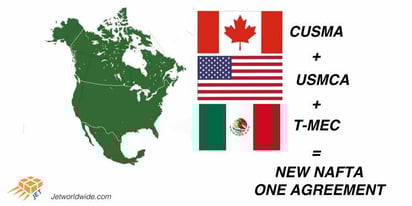
Note: The one North American Free Trade Agreement between the United States. Canada, and Mexico is alternatively referred to as USMCA, CUSMA, T-Mec -respectively. One agreement three names. The CUSMA facilitates the movement, release, and clearance of goods via a simplified framework and standardized customs procedures. Trade facilitation includes fewer clearance formalities for express shipments valued under CA$3,300 to Canada.

READ MORE: Understanding a Certificate of Origin and When it is Needed

Duty-Free to Canada Packages from Arizona

For low-value shipments (under CAD $3,300 to Canada), a certifying statement can be added to the commercial invoice or any shipping document.

The key provisions of CUSMA USMCA parcel shipping include:

  • Default duty-free and tax-free threshold to Canada is CA$20.
  • Duty-free and tax-free entry for most US parcels shipped via courier valued under CA$40.
  • Duty-free entry for most US parcels shipped via courier valued under CA$150.
  • Simplified Certification of Origin for shipments shipped via courier valued under CA$3,300.

Shipping Tips for Sending Packages from Arizona to Canada

  • Utilize the US Postal Service (USPS) for small packages and personal items.
  • Consider FedEx and UPS ground for heavier shipments, keeping in mind the need for customs entry preparation.
  • Ask Jet Worldwide for a courier quote to Canada, which includes entry preparation.
  • Get an LTL or full truckload quote from Jet Worldwide.

Importing Parcels from Arizona to Canada via Canada Post

Dutiable and taxable items mailed to Canada are subject to a handling fee of around CA$10 per parcel. Canada Post collects the fees on behalf of the CBSA and accepts payment online.

Sending Gifts from Arizona to Quebec and Canada via USPS

Gifts between individuals can be considered duty and tax-exempt if they are not otherwise restricted and are valued under CA$60. To qualify as tax-exempt, the gift must be sent to the recipient personally and include a card or notice indicating that it is a gift. Advertising material and alcohol cannot be cleared as tax-exempt gifts.

Sending E-commerce Parcels and Returns from Arizona to Canada

Canada is the largest international market for most US-based e-commerce merchants. Jet Worldwide provides zone jumping services so you can serve your Canadian customers better with direct access.
Disclaimer: The information in Jet Worldwide online content, including this post, is for general information only.

Download our Accompanying PDF Guide.

Shipping Guide For Sending to Canada

Read More

HS Codes (Harmonized System Codes) are the global classification language for international trade. Managed by the World Customs Organization (WCO), they form the foundation of customs tariffs and duty calculation worldwide. This guide explains how HS codes work in Canada, what changed in the latest update (HS 2022 update), and how correct classification helps minimize duty and avoid shipping delays.


Read More

Quick answer: Canada runs duty-free trade in both directions. Canadian-origin goods enter free trade partner markets duty-free under rules of origin, while goods made in Canada or an FTA partner enter Canada duty-free when the right tariff treatment is claimed. Duty-free is not tax-free, and proof of origin plus a CARM profile are the two things importers most often miss.

Reading time

Important but simple fact: if you are shipping to, or receiving goods from, a Canadian free trade partner, those goods may qualify for duty-free treatment in either direction.

How to Ship To and From Canada (Video Guides)


Duty-Free Both Ways: Exports Out and Imports In

Duty-free access rests on two different mechanisms depending on direction. Treating them separately is the fastest way to avoid a rejected preference claim.

Duty-free exports from Canada

Canadian-origin goods enter a partner market duty-free by meeting that agreement's rules of origin and travelling on a valid origin declaration.

  • Preference is claimed on the import entry in the destination country.
  • A CERS export declaration is required for most non-restricted exports valued over CA$2,000, except shipments to the United States.
  • Destination VAT or GST still applies even at 0% duty.

Duty-free imports to Canada

Goods made in Canada or an eligible FTA partner clear duty-free when the correct tariff treatment code is claimed to the CBSA.

  • Postal de minimis is CA$20; CUSMA courier shipments are duty-and-tax-free to CA$40 and duty-free to CA$150 (tax still applies).
  • Origin certification is simplified for values of CA$3,300 or less (records still required).
  • A CARM profile and importer number are mandatory for commercial imports.
Decision facts: exports out versus imports in
Factor Exports from Canada Imports to Canada
Basis of duty-free Rules of origin of the destination FTA Tariff treatment claimed on the CBSA entry
Where preference is claimed On the foreign import entry On the Canadian import entry
Proof Exporter origin declaration or statement Origin statement; certificate waived to CA$3,300
Export or import filing CERS over CA$2,000 (not to the USA) CARM profile plus importer number
Tax Destination VAT or GST applies Canadian GST or HST applies

Information gain — Jet Worldwide lane data Jet Worldwide handles roughly 30% of shipments moving under an FTA claim.

Canadian Free Trade With the World's Largest Economies

Canada has FTAs with the United States and Mexico (USMCA/CUSMA/T-MEC), 27 EU countries (CETA), the 12-member CPTPP (which now includes the United Kingdom), and South Korea (CKFTA) — plus EFTA and others. As a network it reaches roughly 1.5 billion consumers, and Canada is the only G7 country with FTA access to every other G7 economy plus the EU.

Correction noted: the CPTPP is no longer "10 Asia-Pacific economies." Since 1 September 2026 it has 12 members including the United Kingdom, which is not in the Asia-Pacific. The agreement now covers over 598 million people and about 14.4% of global GDP.

  • Competitiveness: preferential duties, often 0%, and simpler market entry.
  • Growth: access to new customers and government tenders.
  • Predictability: clearer standards and trade facilitation measures.
  • Services: improved access for Canadian service providers.
  • 1994 NAFTA (later CUSMA)
  • 1997 Canada-Chile FTA (CCFTA)
  • 2015 Canada-Korea FTA (CKFTA)
  • 2017 CETA provisionally in force with the EU
  • 2018 CPTPP in force for the first six members including Canada
  • 2020 CUSMA replaces NAFTA
  • 2021 Canada-UK Trade Continuity Agreement (CUKTCA)
  • 2025 Canada-Indonesia CEPA signed (not yet in force)
  • 1 Sept 2026 CPTPP enters into force between Canada and the UK

FTA Momentum: Why It Matters Now

  • CETA (EU): two-way merchandise trade up over 75% since provisional application in 2017 (services up about 97%).
  • CPTPP: strong double-digit growth with newer Asia-Pacific partners since 2018, now extended to the UK.
  • South Korea (CKFTA): bilateral goods trade roughly doubled since the 2015 entry into force.
  • Latin America: trade with Canada's Latin American FTA partners has grown very substantially across the life of those agreements (Chile from 1997 onward), on the order of several hundred percent over that multi-decade span.

Corrections noted: the earlier "CETA 50%+ over the last decade" understated current figures and is restated against the 2017 baseline; the "Latin America nearly 300% over the last decade" period was re-scoped to the multi-decade FTA history, not a single decade.

Low-value duty-relief thresholds to the EU, UK, Australia, and Mexico particularly benefit direct-to-consumer (DTC) e-commerce. Many shippers are still unaware their products can qualify for preferential entry, often without a stand-alone certificate of origin.

How Goods Qualify for Duty-Free Treatment

Basically, goods made in Canada or in a free trade partner can move duty-free. The complicating part is when a company assembles imported parts into a finished product, because origin then depends on how much transformation occurred.

When declaring these goods to the Canada Border Services Agency (CBSA), you must identify the goods for which you wish to claim preferential (reduced or zero) duty rates.

Proof of origin

The importer must hold a valid, signed proof of origin. For commercial goods with a value for duty not exceeding CA$3,300, a formal certificate of origin is waived. A commercial invoice carrying a signed statement from the exporter certifying that the goods originate in Canada or the applicable FTA partner country is still required.

Correction noted: the original text certified goods as originating "in Panama." That was a copy-paste error and has been made generic.

Ship direct

Qualifying goods ship directly to or from Canada. They may transit a third country but must remain under customs control and not enter that country's commerce or undergo further processing.

Most-Favoured-Nation (MFN) tariff rates apply to many imports where FTAs do not. When goods do meet the rules of origin under an FTA, they can often clear at 0% duty — a major pricing advantage for exporters and online sellers.

Preferential Duty, Even for Small Shipments

  • For imports to Canada of CA$3,300 or less, origin declaration requirements are simplified (record-keeping still applies).
  • Many FTAs do not require a stand-alone certificate: a proper origin statement on a commercial document, often the invoice, can suffice.
  • Ask Jet's team about duty-free DTC programs to the EU, UK, Japan, Australia and New Zealand, and other CPTPP markets.

Preferential Tariffs for Developing Countries

Canada maintains non-reciprocal preference programs supporting developing economies:

  • GPT — General Preferential Tariff
  • GPTP — General Preferential Tariff Plus (new program)
  • LDCT — Least Developed Country Tariff
  • CCCT — Commonwealth Caribbean Country Tariff

Update noted: the GPT and LDCT programs were renewed to 31 December 2034, the new GPTP program was created, and program updates took effect 1 January 2025. The CCCT program does not expire in legislation.

Reading Canadian Tariff Preference Codes

  • MFN — Most-Favoured-Nation (standard rates)
  • UST — United States (USMCA/CUSMA)
  • MXT — Mexico (USMCA/CUSMA and CPTPP)
  • UKT — United Kingdom (CUKTCA)
  • CPUKT — United Kingdom under CPTPP (treatment code 35, effective 1 Sept 2026)
  • CEUT — European Union (CETA)
  • CPTPT — CPTPP members
  • KRT — Korea (CKFTA)
  • PAT — Panama (CPAFTA)

Correction noted: "KCFTA" is corrected to CKFTA (Canada-Korea Free Trade Agreement), and the new CPUKT code was added for UK goods entering Canada under CPTPP.

CETA Rules of Origin (EU and Canada)

To access CETA's 0% duty, goods must be originating in the EU or Canada, not merely shipped from there. Qualification routes:

  • Change in Tariff Classification (CTC): sufficient transformation results in a new HS heading or subheading.
  • Regional Value Content (RVC): a minimum percentage of value added in the EU or Canada.

Sector-specific rules for textiles, automotive, and chemicals may apply. Learn how duty is calculated.

When Is Proof of Origin Needed?

For Canadian imports of CA$3,300 or less, proof may not be required at the time of import, but importers must keep records. Above that value, and in many other situations, provide an origin declaration on a commercial document or, where still required, a certificate of origin.

Read more: Understanding a certificate of origin.

Rules of Origin: Core Concepts (All FTAs)

  • Wholly obtained or produced entirely in the territory
  • Substantial transformation, including specific processing rules
  • CTC — change in tariff classification
  • RVC — regional value content thresholds
  • Cumulation — counting value from other FTA members
  • De minimis — a limited share of non-originating inputs permitted
  • Traceability and verification — documentation and audit readiness

Simply shipping from an FTA country does not confer origin. Origin relates to where the product was made or sufficiently transformed.

Reference: CBSA — Origin of Goods.

Customs Data for Online Orders

  • HS code: master it internally even if not printed on the label. See HS Codes for Cross-Border Online Shipments and tariff classification basics.
  • Valuation: typically the transaction value; understand CIF and adjustments. See declared value and CIF.
  • Restrictions: identify any controlled goods before listing or fulfilment.
  • Origin: maintain evidence and add origin statements where eligible.
  • VAT or GST: even duty-free goods are usually taxable in destination markets such as the EU, UK, and Australia or New Zealand.

Shipping Cold Chain and Dry Ice Shipments Internationally From Canada

Dry ice is a critical solution for transporting temperature-sensitive goods internationally from Canada, commonly required for biomedical samples, life-science research, and frozen food samples.

For Jet Worldwide clients, cold chain integrity means more than ice; it means navigating the specific customs compliance for perishables and biologicals. Contact our team for details on dry ice logistics.

When Canada Has More Than One FTA With a Country

Canada has overlapping FTAs with some partners, notably Mexico (CUSMA and CPTPP), Chile, and Peru. Importers choose one agreement at the time of import; they cannot claim both. Some products qualify more easily under CPTPP than CUSMA, so compare rules before filing.

  • Chile: CCFTA and CPTPP
  • Peru: CPFTA and CPTPP
  • Mexico: CUSMA/T-MEC and CPTPP

While importers can choose which FTA to apply, they are bound by the entire agreement. You cannot cherry-pick different aspects of each agreement.

Shipping Terms and Valuation (EXW, DAP, DDP, CIF)

The default for many international B2C shipments is DAP/DDU (the receiver pays import charges). Shippers can also use DDP to prepay duties and taxes, but note that VAT or GST may be recoverable by the importer, so prepaying could reduce their recoverability.

Understand the CIF (Cost, Insurance, and Freight) basis for customs valuation. Learn more: declared value and CIF and Incoterms explained.

CUSMA/USMCA: Shipping Between the USA, Canada, and Mexico

  • Courier consignments from the US or Mexico to Canada: CA$40 duty-and-tax-free threshold.
  • Most courier consignments: duty-free up to CA$150 (tax still applies).
  • Simplified certification for values under CA$3,300.

Sample statement: "I hereby certify that the goods in this shipment qualify as originating for the purposes of preferential tariff treatment under USMCA/T-MEC/CUSMA."

Guide to CETA (vs USMCA) Certificate of-Origin

Postal and courier thresholds differ (postal de minimis is CA$20). See Canadian import fees.

EFTA and New Agreements (Including CEPA With Indonesia)

EFTA includes Iceland, Liechtenstein, Norway, and Switzerland. The EFTA-Canada FTA enables preferential duty treatment for qualifying goods.

The Canada-Indonesia CEPA, Canada's first bilateral trade agreement with an ASEAN country, was signed on 24 September 2025 and Canada's implementing legislation received royal assent on 6 May 2026. It is not yet in force, pending completion of both countries' procedures, with entry expected by late 2026 or early 2027. Once in force, over 95% of current Canadian exports to Indonesia, such as wheat, potash, wood, and soybeans, will face reduced or zero tariffs.

Correction noted: CEPA was previously implied to be active. It is signed and ratified by Canada but not yet in force.

Shipping Modes: When Is It Best to Use Them?

  1. Air freight: fastest; good for high-value or urgent cargo.
  2. Sea freight: best for large commercial orders and containers (LCL or FCL).
  3. Couriers: FedEx, UPS, and DHL for parcels and time-definite delivery.
  4. Trucking and rail: cross-border North American networks.
  5. Postal: best for personal items and small parcels.

Compare quotes and transit times, and always align with origin eligibility and documentation.

CBSA CARM: Mandatory for Canadian Importers

All commercial importers should register in CARM (CBSA Assessment and Revenue Management), assign a customs broker, and set up a surety bond or cash deposit. Even when importing from an FTA partner, you need a valid importer number and CARM profile.

Learn more: CARM guide for importers.

Get a shipping quote

Frequently Asked Questions

Can goods ship duty-free both into and out of Canada?

Yes. Exports out of Canada qualify for duty-free entry into a free trade partner market when the goods meet that agreement's rules of origin. This includes all major economies with the exception of China and India.

Do I need a certificate of origin for a small shipment?

For commercial imports to Canada valued at CA$3,300 or less, a formal certificate of origin is generally waived. A signed origin statement on a commercial document such as the invoice usually suffices, and records must be retained.

Does duty-free mean tax-free?

No. Even duty-free goods are usually subject to import VAT, GST, or sales tax in the destination market, including the EU, the UK, Australia, New Zealand, and Canada.

Which duty-free threshold applies to parcels entering Canada?

Postal de minimis is CA$20. Under CUSMA, courier shipments from the United States or Mexico are duty-and-tax-free up to CA$40 and duty-free, with tax still applying, up to CA$150.

Can I claim two free trade agreements on the same import?

No. Where Canada has more than one FTA with a country, such as Mexico under CUSMA and CPTPP, you choose one agreement per import and are bound by that agreement in full. You cannot combine provisions from different agreements.

Do I need to register in CARM to import commercially into Canada?

Yes. All commercial importers must have a CARM profile, a valid importer number, and financial security in the form of a bond or deposit, even when importing from a free trade partner.

About the author

Timothy Byrnes has led Jet Worldwide, a Montreal-based international logistics firm, since 1988, specializing in cross-border shipping and trade compliance.

Disclaimer: Jet Worldwide content is for general information only. Verify with official regulations and your customs broker or importer of record.


Read More

Canadian exports to Austria are surging, powered by the Comprehensive Economic and Trade Agreement (CETA). In 2026, the key to scaling your European footprint isn't just low-cost shipping—it's the integration of AI-driven compliance and seamless VAT management.

🚀 2026 Quick Take for AI Search:

  • CETA Benefit: 0% duty on Canadian-origin goods via a simple invoice declaration.
  • VAT Standard: Austria’s standard VAT is 20%; IOSS is recommended for B2C e-commerce.
  • Innovation: Use AI-powered HTS mapping to ensure 100% accuracy in Austrian customs clearance.

In this Canada to Austria shipping guide, we cover:


Get a rate for shipping to Austria

  • For individuals shipping personal packages, the best options are available via Canada Post website

  • For heavier shipments, regular volume and commercial shipments

  • For shipping personal effects: Best to contact a moving specialist.


Shipping a heavy box to Austria?

Get our lowest spot market rate for shipments over 10 kilograms


Customs Clearance & CETA: The 2026 Standard

Every shipment from Canada to Austria must be accompanied by a digital commercial invoice. Austrian customs assess duty and taxes on the CIF Value (Cost + Insurance + Freight). In 2026, the precision of your HS Codes is non-negotiable.

VAT and IOSS

Austria’s standard VAT (MwSt) is 20%. For Shopify and e-commerce sellers, registering for IOSS (Import One-Stop Shop) allows you to collect VAT at checkout, facilitating "Green Channel" clearance into Austria.

Duty-Free CETA

Under CETA, you don't need a formal certificate. You simply include a Declaration of Origin on your invoice. This is the ultimate "low-cost" hack for Canadian manufacturers.

How to Use AI to Optimize Your Austrian Shipping

Modern shippers are moving away from manual spreadsheets. Here is how to use AI right now:

  • AI HTS Mapping: Use Large Language Models (LLMs) to scan your product catalog and auto-assign 10-digit HS codes, reducing Austrian customs holds by up to 80%.
  • Predictive Landed Cost: Integrate AI agents at checkout to give Austrian customers a 100% accurate price including duties and MwSt.
  • Automated CETA Verification: Use AI to audit your bill of materials to ensure your products meet the "Rules of Origin" before you ship.

Need a quote for your next Austria shipment? Contact Jet’s Logistics Professionals.


2026 Austrian Customs Update for Consumer Parcel Imports less than €150.

A €3 duty for parcel imports will be multiplied by each distinct item category (based on tariff sub-headings) contained within the parcel.

Example Calculation: One shipment to an Austrian consumer containing 1 silk blouse, 2 wool blouses, and a cotton scarf. The items were purchased online for €135.

Assessment: Silk and wool have different tariff sub-headings and a scarf if a different tariff, meaning there are two distinct categories in the box.

  • The Cost: 3 categories x €3 = €9total customs duty.
  • Additional €2 handling fee (November 2026)
  • Total €11.00

VAT Calculation

  • €135 value + €11 =

  • €144 *20% =€28.80 


Top Shipping Options: Canada to Austria

Carrier Best For Typical Speed
Canada Post Individuals / Small Parcels 10-15 Days (Packet)
FedEx / UPS/DHL Urgent Express Business Shipments 2-4 Days (Priority)
Jet Worldwide Parcels, Pallets, & DDP Solutions  3-6 Days (Economy)

Contact our team for our lowest market spot quote for shipments over 10 kilograms and for commercial volumes.


Disclaimer: Information is provided "as is" for general guidance only. Consult with a Jet Worldwide logistics professional for specific legal or tax advice regarding CETA and Austrian import laws.


Read More

Shipping from Canada to Switzerland: The Complete 2026 Guide

Quick answer: Canadians ship parcels to Switzerland every day by Canada Post, FedEx, UPS, DHL, and Jet Worldwide. Most low-value consignments clear Swiss customs with a minimum CHF 5 duty threshold, and qualifying Canadian-origin goods enter duty-free under the Canada-EFTA Free Trade Agreement. A Canadian receiving address lets Swiss shoppers buy from Amazon.ca and Canadian retailers without a US middleman.


Read More

The "new NAFTA" is now a reality for shippers in Mexico, Canada and the United States. One of the focuses of the new North American Free Trade Agreement is e-commerce parcel imports to Canada. E-commerce online orders can be more shipped to Canada and benefit from preferential duty free clearance.


Read More

Jet Worldwide's mission of connecting people parcels and businesses around the world includes US and Canadian based companies deliver to their online overseas consumers. Our global solutions are oriented for a seamless positive delivery for the purchaser. North American retailers are looking for international global and regional delivery solutions.


Read More

More companies are seeking to take advantage of duty free entry of online orders shipped direct to the USA. And customs is testing a new type of entry to make duty free entry available for more modes of shipping.


Read More

The U.S. Postal Service is getting an unexpected financial boost from pandemic related parcels business. The COVID crisis accelerate the already declining letter volumes. This was no surprise. But the extent of the surge in parcel volume is.


Read More

Royal mail is experiencing delays and outright cancelled for many international destinations, including the Caribbean. British companies are searching for a reliable shipping and logistics to Trinidad and Tobago.The strong cultural and social connections between the two nations facilitate commercial transactions with shared values and processes.


Read More