
Japan and Canada's economic partnership continues to grow under the CPTPP trade pact. Japan is one of Canada's largest sources of foreign direct investment from Asia and is among Canada's top trading partners. Canadian and Japanese companies rely on low-cost parcel delivery to strengthen the connection between their customers and suppliers.
The most common goods shipped from Japan to Canada include automobiles, auto parts, power turbines, chemical and engineering equipment, and office machinery. This guide explores the different ways of shipping from Japan to Canada.
Shipping from Japan to Canada is fastest by courier or air, usually 3 to 7 business days, and cheapest by ocean for loads over 500 kilograms. Japan Post suits personal parcels up to 2 kilograms. Japan-origin goods that meet CPTPP rules of origin can clear Canadian customs duty-free with a simple certification of origin.
 Expand your logistics options from Japan. Get a quote now.
Japan and Canada trade at a glance
Much of the bilateral merchandise trade between the two countries moves by ocean and air freight. Canadian companies maintain a significant and diverse presence in Japan, notably in automotive, information and communications technologies, financial services, and forestry.
| Fact | Detail |
|---|---|
| Bilateral merchandise trade | About CAD 36 billion (2024 to 2025) |
| Japan's rank | Canada's fifth-largest merchandise trading partner |
| Canadian exports to Japan | CAD 14.6 billion (2025) |
| Imports from Japan | CAD 21.1 billion (2025) |
| Foreign direct investment | Japan is Canada's largest source of FDI from Asia |
| Trade agreement | CPTPP, in force between Canada and Japan since 30 December 2018 |
Download the accompanying PDF: Shipping Japan to Canada.
Jet Worldwide provides Asian, Canadian, and global logistics support, including transportation, rate comparison, storage, and supply chain management. Because we are not tied to a single carrier or process, our logistics support augments your team.
Best ways to ship from Japan to Canada
The best option depends on the type and size of your goods, the speed you need, and your budget. Common options:
| Mode | Best for | Typical transit | Cost profile |
|---|---|---|---|
| Japan Post | Personal parcels up to 2 kg | Varies by service | Lowest for small personal items |
| Courier (FedEx, UPS, DHL) | Time-sensitive parcels | Express about 3 days; economy about 7 | Higher; door-to-door with full tracking |
| Air freight | Consignments up to about 100 kg | A few days | Better value than courier at mid weight |
| Ocean (LCL or FCL) | Pallets and loads over 500 kg | 30 to 60 days | Lowest per-unit cost for bulk |
Partner with Jet Worldwide
Ensure your shipments are classified correctly, delivered on time, and fully compliant.
Request a Quote Talk to an ExpertHow long does shipping from Japan to Canada take?
Shipping time can be as fast as a couple of days by courier or air. Ocean transit averages 30 to 60 days. The quoted ocean time is often shorter, but allow for scheduling, port, and inland delays.
| Service | Typical transit |
|---|---|
| Courier express | About 3 business days |
| Courier economy | About 7 business days |
| Air freight | A couple of days to a few days |
| Ocean (LCL or FCL) | 30 to 60 days (about two months) |
Ocean and consolidation shipping from Japan to Canada
The average ocean transit from Japan to Canada is about two months. Useful background on shipping ocean to Canada is available on our blog.
LCL and consolidation on weekly schedules
Consolidation and less-than-container-load services to Canada are accessible from Tokyo and Osaka on weekly schedules. Total transit is longer than air, and during winter months rail from Vancouver to eastern Canada can experience delays.
Air versus ocean
Because ocean shipments carry many minimum surcharges, smaller consignments are often cheaper by air, especially door-to-door. As a rule of thumb, shipments under 100 kilograms are usually cheaper by air, while cargo over 500 kilograms is much less expensive by ocean.
Shipping boxes and packages via Japan Post
As the national postal service, Japan Post offers low-cost delivery to Canada for small parcels. The Small Packet option covers items up to 2 kg. Current Japan Post options for parcels to Canada include:
- EMS (Express Mail Service)
- International Air Packet (formerly International ePacket Light, renamed 1 June 2026)
- Small Packets (air or surface, up to 2 kg)
- International Parcel and International Airmail
The maximum weight limit is generally 30 kg, depending on the service. Shipments sent via Japan Post benefit from import and final delivery through Canada Post under the Universal Postal Union agreements.
Service note: postal acceptance to Canada has been temporarily suspended at times during Canada Post labour disruptions, and Japan Post retired several older services (International ePacket ended 30 September 2023). Confirm current availability before you rely on a postal option.
Need help measuring your parcel? Print a handy ruler: ruler on A4 paper or a ruler on US letter paper.
Courier options: FedEx, UPS, DHL, and Purolator
FedEx and UPS are North America's largest carriers and, along with DHL, offer reliable parcel delivery from Japan to Canada.
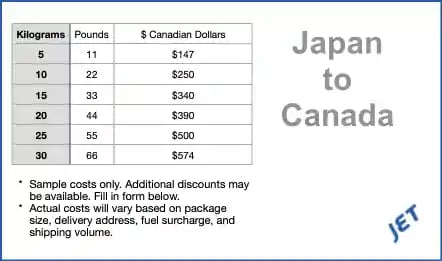
Courier options from Japan to Canada include:
- International air priority from Japan to Canada
- International economy delivery from Japan to Canada
Purolator to Canada
Purolator is one of Canada's leading domestic carriers and offers international express delivery through partners such as UPS.
Shipping from Japan to Canada with Jet Worldwide

Benefit from Jet Worldwide's international logistics expertise since 1988. Jet moves parcels, pallets, and online orders between Japan and Canada, and also handles the reverse lane from Canada to Japan by post, courier, air, and sea freight.
For a quote, provide details such as your shipping volume, items, and the average value and weight of each parcel. The more detail, the better. Get shipping rates Japan to Canada.
On Jet Worldwide's Japan-to-Canada consolidation lane, supplier shipments from Tokyo and Osaka into a single weekly consolidation has lowered the average landed cost per kilogram significantly.
Japan export declarations and shipping terms
Japan export declarations
For a consignment from a business or business address, a corporate identification number is required before export. Japan's corporate number is 13 digits, or 17 digits when combined with the 4-digit NACCS branch code. Exporters must declare to Japan's Director-General of Customs, providing the quantity, classification, unit price, and related details. An export permit is issued following any required examination.
Shipping terms: DDP versus DDU
The default for international shipments is Delivery Duty Unpaid (DDU), and carriers often use Ex Works (EXW), which assigns import costs (duty, taxes, and other fees) to the receiver, that is, the importer in Canada. The shipper in Japan can instead choose Delivery Duty Paid (DDP), which most carriers offer. See also international shipping terms.
There is a trade-off to paying import fees on behalf of the receiver. Much of the import charge is provincial sales tax, and a Canadian importing business may otherwise be able to recover GST and PST.
Mandatory registration with Canadian customs (CARM)
Commercial importers must have an import number and register in CARM.
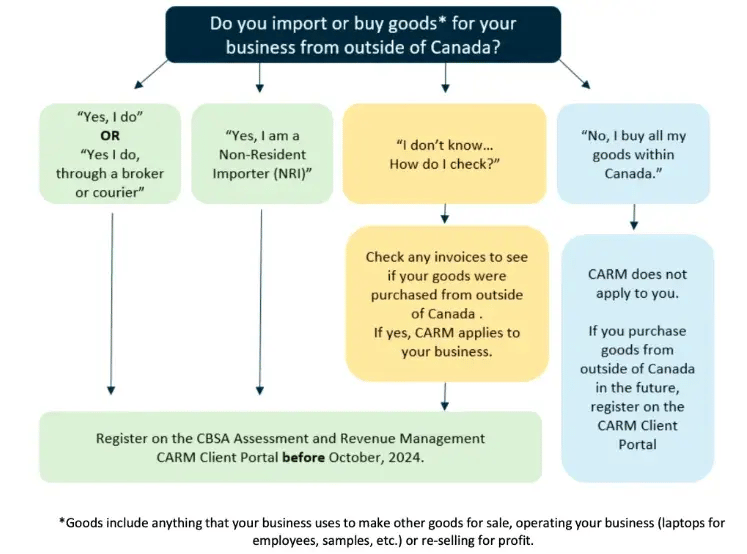
This CBSA portal lets importers assign a customs broker and requires financial security (a surety bond or a deposit). How to register for CARM.
Import fees and duty-free thresholds
Goods imported to Canada from Japan are subject to import duties and to federal and provincial sales taxes. Most goods valued under CAD 20 clear free of duty and tax. Commercial goods valued under CAD 3,300 can be processed through the Low Value Shipment (LVS) simplified stream. The higher CUSMA de minimis thresholds apply only to shipments from the United States and Mexico, not from Japan.
Other things to consider when importing from Japan:
- Importer of record: for goods sold direct to a consumer, the consumer is the importer of record; if a company sells and imports the goods, the company is the importer of record and needs an importer number.
- Tariff classification for all imports (read more about HS codes).
- Health Canada approvals for regulated products.
- Safe Food for Canadians requirements may apply to food.
- GST, HST, and provincial taxes (see common Canadian import fees).
- Country of origin declaration is required for all imports.
- Valuation is a key part of the CBSA declaration (read more about valuation).
- Labelling for goods to Canada may require both French and English.
CPTPP duty-free import and proof of origin
The Comprehensive and Progressive Agreement for Trans-Pacific Partnership (CPTPP) is a free trade agreement shared by Canada and Japan, in force between the two countries since 30 December 2018. It reduces barriers to trade and provides preferential duty-free import for qualifying goods. Benefit from CPTPP duty-free import to Canada.
Canada's Most-Favoured-Nation (MFN) tariff rates generally apply to imports from Japan. Goods that meet the CPTPP rules of origin may instead qualify for preferential duty-free import. Note that shipping from Japan is not the same as shipping Japan-origin goods: goods with proper proof of origin can ship from Japan and clear duty-free in Canada.
Proof of origin
The key to any trade agreement is ensuring goods qualify under the rules of origin. Country of origin is not simply where the goods ship from.
A good is originating under CPTPP when it is:
- Wholly obtained or produced entirely in one or more CPTPP countries.
- Produced entirely from originating materials of one or more CPTPP countries.
- Produced in Canada or another CPTPP country using non-originating materials that undergo the required production or transformation.
Buying a good in Japan does not by itself qualify it for preferential treatment, and the importer must keep supporting records for all shipments.
Benefits of a certificate of origin
Country of origin lets Canadian customs determine whether preferential duty-free import applies under CPTPP. It also supports regulatory actions such as quarantine and import quotas. See important information on a certificate of origin, and explore Canada's free trade agreements.
Simplified certification under CAD 3,300
Consignments of Japan-origin products valued under CAD 3,300 need only a simple certification of origin to claim CPTPP preferential treatment. To qualify:
- Include a signed statement by the importer, exporter, or producer certifying the goods originate from a CPTPP country. We recommend adding a standalone supporting statement in addition to the commercial invoice.
- The goods must meet the origin rules; for example, marks indicating the goods are not a product of a CPTPP country will disqualify them.
- For imports not exceeding CAD 3,300, the formal proof-of-origin requirement is reduced, but the importer must keep records available on request.
Textbooks, e-commerce, and returns
Shipping Canadian textbooks between Canada and Japan
Several Canadian international schools in Japan, in Kobe, Yokohama, and Tokyo, offer a Canadian curriculum. Jet Worldwide receives, consolidates, and ships orders direct to Japan. Read more: shipping Canadian textbooks and supplies.
E-commerce orders to Japan
Canadian retailers can send e-commerce orders direct to Japan with efficient clearance and low-cost last-mile delivery. Jet Worldwide provides both postal and commercial clearance options for high-volume imports to Japan.
Online order returns from Canada to Japan
For simpler processing of your Canadian customers' returns and Canadian Amazon (FBA) removal orders, contact Jet's team about setting up return processes from Canada.
FAQs: shipping from Japan to Canada
How long does shipping from Japan to Canada take?
By courier or air, delivery can be as fast as a couple of days, with express courier usually within 3 business days and economy around 7 business days. Ocean freight averages 30 to 60 days, roughly two months.
What is the cheapest way to ship from Japan to Canada?
For individuals sending small personal parcels up to 2 kilograms, Japan Post is usually cheapest. For shipments up to about 100 kilograms, economy air is often the best value, and for loads over around 300 kilograms, ocean freight is the most economical.
Can Japanese goods enter Canada duty-free?
Yes, when goods meet the CPTPP rules of origin and are supported by proof of origin. However, simply buying a good in Japan does not by itself confer origin duty free status.
Do I need to register with CARM to import from Japan to Canada?
Commercial importers need an import number and must register in the CBSA Assessment and Revenue Management (CARM) portal, which is now the system of record. CARM lets you assign a customs broker and requires financial security.
What is Canada's duty-free threshold for low-value imports from Japan?
Most goods valued under CAD 20 clear free of duty and tax. Commercial shipments valued under CAD 3,300 can use the Low Value Shipment simplified process.
Which documents are needed to import from Japan to Canada?
A commercial invoice with HS codes, a packing list for multiple boxes, and an air waybill or bill of lading. To claim CPTPP duty-free treatment, include proof of origin, and keep supporting records even when a formal certification is not required.
Get a shipping quote between Japan and Canada
Disclaimer: the information in all Jet Worldwide online content, including this post, is for general information only.