Importing to Canada: A Complete 2026 Guide
Build a compliant, cost-efficient Canadian import program. This guide includes helpful short videos and covers CARM registration, HS classification plus valuation, duties and taxes, Incoterms, de minimis thresholds, and best shipping methods.
Last Updated: 2026 Market Update
Executive Summary
Get local Canadian Support including: Having a Canadian address to receive your goods (including FBA removal orders). Ship in bulk to Canada to our facility for storage and on-demand shipping across Canada - from Canada!
Contact our team for rates and information.
- Compliance first: Ensure correct HS classification plus declared valuation for CBSA.
- Cost clarity: Model landed-to-door costs including duty plus GST/HST plus fees.
- Confirm Responsibility: Use Inco-terms (DDP/DAP) to define who pays import fees.
- Carrier Agnostic: Scale using a mix of express, airfreight, plus ocean flows.
Download: PDF Import Guide to Canada
Getting Started: Your Import Checklist
- Define the importer: Will simply ship to a Canadian company or as a Non-Resident Importer (NRI).
- If a Canadian importer, make sure they have an importer ID attached to their BN#
- In the case of an NRI, Register for CARM: Setup roles plus payment methods in the CBSA portal.
- Classify products: Assign HS codes plus check for permits or labeling requirements.
- Choose clearance path: Integrated express brokerage (LVS) or independent broker.
CARM and Importer Accounts
The CBSA Assessment and Revenue Management (CARM) portal centralizes all importer activities. Registration is mandatory for all businesses importing commercially into Canada.
Terms of Sale - "inco-terms"
Before importing to Canada, it is important to clarify who - between the buyer and seller - is responsible for shipping, import duty and other costs. This is commonly referred to as Inco-terms. Most carriers assign the term are EXW by default. Although not official inco-terms, carries also use terms such as delivery duty paid (DDP) or Delivery Duty Unpaid (DDU).
Non-Resident Importer for Foreign Companies
By becoming a non-resident importer (NRI), foreign companies can essentially act as their own distributor across Canada. And doing so, you are able to import go to Canada without having to involve your Canadian customer in the clearance process. This is a usually popular program for foreign importer, most notably from the United States.
HS Codes plus Valuation
Classification drives duty rates. The clear broad description of the importing product along with material, function, plus intended is necessary to ensure a correct classification. In most cases, the correct value to declare is the amount paid or payable for the goods.
- Validate valuation methods (Transaction Value is most common = value paid or payable for importing goods)
- Check for Free Trade Agreement eligibility to eliminate duty.
...............
Landed Cost: Forecasting Your Spend
Read More: Common Canadian Import Fees to Consider
HS code or tariff classification determines the rate of duty, most often expresses as a percentage of value. The Country of origin matters most when importer is requesting duty free import via a Canadian Free Trade agreement.
| Component | Factors to Watch |
|---|---|
| Duty | Rate by HS classification plus country of origin. |
| GST/HST | Calculated on value plus duty based on destination province. |
| Disbursement | Fee applied when a carrier fronts duty/tax payments. |
USA Shipping Options to Canada
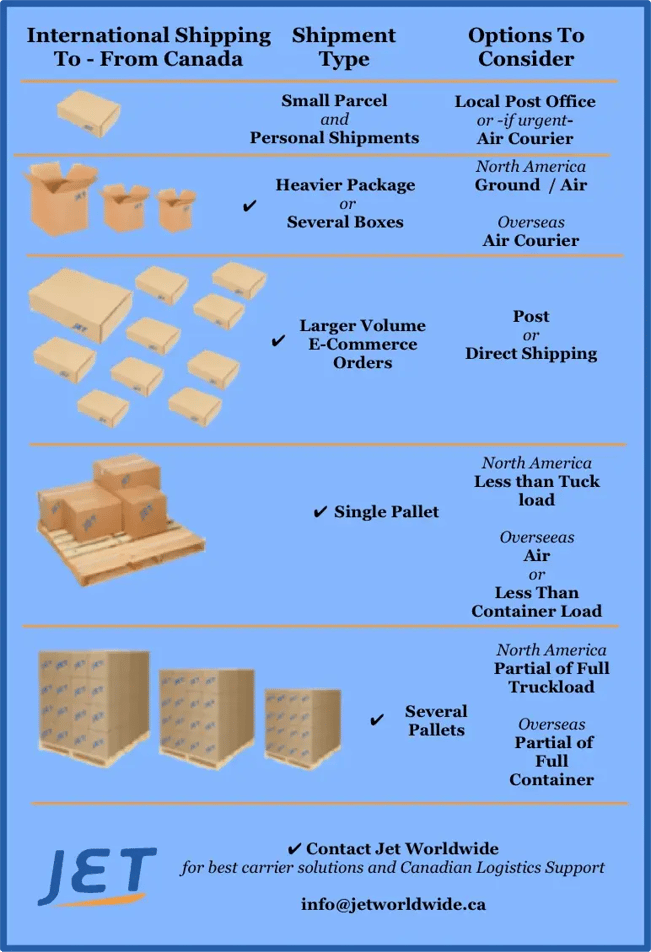
The shipping options to Canada mirror the options from Canada. They include shipping via the local post (for delivery via Canada Post), global courier (FedEx UPS and DHL), airfreight, and ocean.
From the United States the most common options are via ground: courier, LTL, FTL.
Get a shipping rate and support.
Frequently Asked Questions
Who is the Importer of Record?
Either a Canadian entity or an NRI. This a very popular program for American Companies. Essentially, you can act as your own distributor across Canada. Becoming an NRI and having local Jet resources can be the perfect solution. Read more about considering becoming a non-resident importer.
What is the Canada De Minimis?
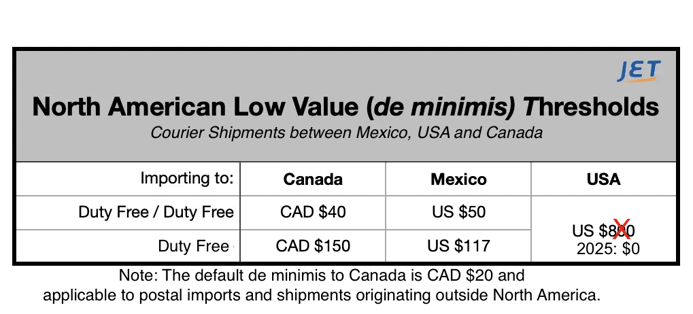
Shipments under $20 CAD are generally duty plus tax-free. For courier shipments from the USA or Mexico, duty-free thresholds rise to $150 CAD, though tax applies after $40 CAD.