
France and Canada share strong economic and social connections, exchanging billions of dollars in trade every year. Furthermore, French and Canadian companies frequently use each other's countries as base operations for regional access to the European Union and North America. If you are a Canadian business looking to expand, we can help you find the absolute best shipping options to France.
Quick answer
The cheapest way to ship from Canada to France is Canada Post surface, under CAD 40 for parcels below 2 kg. FedEx or UPS express costs about CAD 120 to 200 for 4.5 kg. Since July 2026, e-commerce parcels up to €150 pay a flat €3 duty per tariff category, plus 20 percent French VAT.
France and Canada in numbers
CAD 14.2 billion
Two-way merchandise trade in 2024: CAD 4.4 billion in Canadian exports plus CAD 9.8 billion in imports from France
3rd
France's rank among Canada's merchandise export markets in the EU
€196.4 billion
Spent online by French shoppers in 2025, up 7 percent, across 3.2 billion transactions (Fevad)
Investment runs both ways: at the end of 2023, Canadian direct investment in France stood at CAD 13.9 billion and French direct investment in Canada at CAD 14.9 billion. For e-commerce sellers the headline is the size of the French online market, one of the largest in Europe, and the fact that Quebec businesses arrive already speaking the customer's language.
2026 important update: EU customs for parcels to French consumers under €150
Since 1 July 2026, e-commerce parcels to consumers anywhere in the EU, including France, with a value of up to €150 pay a flat €3 customs duty for each distinct item category (based on tariff sub-headings) contained within the parcel. The measure is temporary and scheduled to apply until 1 July 2028.
Example calculation
- The order: 1 pair of leather shoes, 3 cotton T-shirts and 1 polyester-blend T-shirt. Value €125.
- The assessment: footwear falls under an entirely different heading (6403) from T-shirts. Cotton and polyester T-shirts have different tariff sub-headings (6109.10 and 6109.90). That makes three distinct categories inside the box.
- The cost: 3 categories x €3 = €9 total customs duty. The three cotton T-shirts count once.
- The VAT: 20 percent French VAT, either €25.00 charged at checkout under IOSS (20 percent of €125), or €26.80 collected at import without IOSS (20 percent of €134, because import VAT is charged on the value plus duty).
Note: a separate EU handling fee per consignment must be collected by member states from 1 November 2026 at the latest. The amount is set at EU level; about €2 is a common planning figure, not a confirmed rate.

Expand your cross-border opportunity with our logistics professionals. Jet Worldwide has provided international courier and logistics support since 1988. Save more by utilizing the best shipping modes and processes. Contact our team for an initial consultation today.
Lowering your delivery cost to France
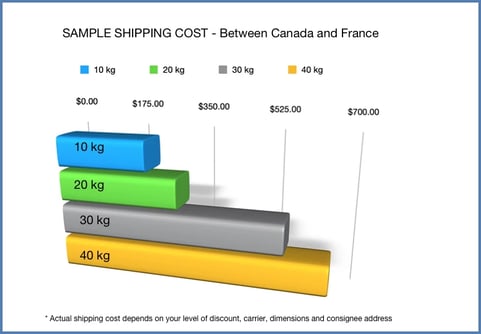
The shipping cost of a package to France depends on the destination address, dimensions, weight and the service level you require. Naturally, the faster your package needs to be delivered, the higher the cost will be.
What is the cheapest way to ship to France?
Canada Post surface packet and parcel options are typically the lowest-cost way to ship from Canada to France. This is the ideal option when the shipment is not urgent and tracking is not necessary. Surface shipments under 2 kilograms can cost less than CAD 40.
Get our lowest spot quote for shipments over 10 kilograms to France and commercial volumes.
Express options: FedEx, UPS and Chronopost
If you need faster delivery, commercial carriers like FedEx or UPS will cost between CAD 120 and 200 for a 10-pound (4.5 kg) package. The actual cost varies depending on your discount level, the specific French address and current fuel surcharges.
If you are looking to grow your online sales to France, explore direct shipping. Jet Worldwide provides access to Chronopost and DPD from Canada. We help you consolidate your orders via direct airfreight from YUL, YYZ or YVR to France, delivered duty paid so your customer has nothing to pay at the door.
Jet Worldwide data
For Canada-to-France e-commerce sellers can move from individual courier parcels to consolidated air freight injected into Chronopost via Jet Worldwide. Contact Jet.
Download our comprehensive PDF guide for more details.
Best Canadian shipping options to France
The transit times for air shipments via commercial carriers generally range from 2 to 4 business days. Here are the main options available:
| Option | Best for | Speed |
|---|---|---|
| Canada Post | Individuals shipping small parcels or personal items | Surface is slowest; air options faster |
| Ocean freight | Large commercial orders and heavy commodities | Slowest, lowest cost per kilogram |
| Air freight | Palletized freight needing faster transit, or high-volume e-commerce | Fast, priced by weight or volume |
| Integrated carriers (FedEx, UPS, DHL) | Reliable express and economy air parcels | 2 to 4 business days express |

Customs clearance and VAT rules
EORI number for imports to France
It is vital to verify the EORI number of the consignee in France. An Economic Operators Registration and Identification (EORI) number is an EU identification number for businesses. It is a mandatory part of the data set required for customs entries across all EU countries.
Import VAT self-assessment (autoliquidation) explained
Businesses identified for VAT in France must self-assess import VAT (autoliquidation de la TVA à l'importation). Instead of paying VAT at the border, the importer declares it on its French VAT return (form CA3) and, where entitled, deducts it on the same return, which removes the cash-flow cost.
- Applies to every business acting as importer of record in France with a French VAT number.
- Requires a valid French VAT number.
- Non-EU businesses generally must appoint a fiscal representative in France, unless their country has a mutual assistance agreement with France. Confirm the current list with French Customs.
- The standard French VAT rate is 20 percent, with reduced rates of 10, 5.5 and 2.1 percent.
Product identifiers (PID) for B2C shipments
Every shipment to a consumer (a business-to-consumer, or B2C, sale) must include product identifier (PID) information for each item, whatever the shipment's value.
PIDs do not apply to business-to-business (B2B) shipments sent to a VAT-registered business.
Duty-free clearance under CETA
The Comprehensive Economic and Trade Agreement (CETA), country-of-origin rules determine if a product is eligible for preferential duty-free treatment.
Shipping personal effects
Personal effects shipped to France can clear free of duty and taxes when you are transferring your main residence to France, and they should be accompanied by a fully detailed inventory clearly marked "Used Personal Effects" and genuinely for personal use only. The conditions are:
- You lived outside the EU for at least 12 months.
- The goods were owned and used for at least 6 months before the move.
- They are imported within 12 months of settling in France.
- You file the Cerfa 10070 declaration with a signed inventory in two copies.
- You do not sell, lend or rent them for 12 months after import.
- Alcohol, tobacco, commercial vehicles and professional equipment are excluded, as are goods for a second home.
Gifts sent by one private individual to another, occasionally and with a value of up to €45, also enter free of duty and VAT.
E-commerce logistics solutions to France

France boasts one of the world's largest online markets, showing a strong affinity for Canadian goods. Canadian companies can benefit immensely from Jet Worldwide's direct shipping and last-mile delivery solutions.
Using France as your EU gateway
- Goods shipped from Canada via France to the rest of the EU can be imported using a French VAT number under customs procedure 42, which exempts import VAT when the goods move straight on as an intra-EU supply to a business customer in another member state.
- We can help set up fiscal representation in France to facilitate final formalities.
- Get accurate duties and taxes estimates well in advance of shipping.
The Quebec advantage, and two French rules to check
French law (the Loi Toubon) requires product descriptions, instructions and warranties for goods sold in France to be in French, so Quebec sellers with French packaging start ahead of most North American competitors. Check vocabulary that differs between Quebec and France before you print. Separately, France runs extended producer responsibility schemes for packaging and many product categories, and sellers shipping to French consumers generally need a unique identifier (IDU) for each scheme that applies to them; the EU Packaging and Packaging Waste Regulation also applies from 12 August 2026. Confirm your obligations with ADEME before you launch.
Getting a shipping quote
Jet Worldwide provides innovative shipping solutions and logistics support between France, the European Union, Canada and the USA. Whether you need economy parcel shipping, direct e-commerce fulfillment or EU warehousing, we have you covered.


2026 to 2028 timeline for shipments to France
- 1 January 2022Import VAT self-assessment becomes mandatory for businesses with a French VAT number.
- 1 July 2026Flat €3 customs duty per tariff category on e-commerce parcels up to €150.
- 12 August 2026EU Packaging and Packaging Waste Regulation applies.
- By 1 November 2026EU handling fee collection starts at the latest.
- January 2027IOSS Right to Use checks expected at EU clearance. Confirm the exact date.
- 1 July 2028Temporary €3 duty scheduled to end as the permanent EU regime arrives.
Related resources
- Commercial invoice for international shipping
- Declared value, CIF and valuation for international shipping
- When to include a certificate of origin
- What is an HS code? Tariff classification basics
- Canada importer registration for CARM
- Canada export declaration (CERS)
- What is a bill of lading or waybill?
- Choosing a Canadian customs broker
- Shipping via ocean freight to and from Canada
- IOSS Right to Use from January 2027
Frequently asked questions
What is the cheapest way to ship from Canada to France?
Canada Post surface packet and parcel options are typically the lowest-cost way. Surface shipments under 2 kilograms can cost less than CAD 40 when the shipment is not urgent and tracking is not necessary.
How much duty does a parcel to France under €150 pay?
A flat €3 customs duty for each distinct tariff category in the parcel, from 1 July 2026 until 1 July 2028. Leather shoes, cotton T-shirts and a polyester-blend T-shirt are three categories, so the duty is €9. French VAT of 20 percent applies on top.
Do I need a certificate of origin to ship Canadian goods to France duty-free?
No. Under CETA, an origin declaration on the commercial invoice is enough, using the prescribed wording and your Canada Revenue Agency business number. The goods must actually originate in Canada.
How does import VAT work for businesses importing into France?
Since 1 January 2022, businesses with a French VAT number self-assess import VAT on their CA3 return instead of paying it at the border. Non-EU businesses generally need a fiscal representative in France.
Can I ship personal effects to France duty-free?
Yes, when you are transferring your main residence to France: you must have lived outside the EU for at least 12 months, owned and used the goods for at least 6 months, and import them within 12 months with the Cerfa 10070 declaration and a signed inventory.
Disclaimer: The information contained in this blog post is for general informational purposes only.