As Jet Worldwide has grown into a leading global resource for Canadian exporters, we’ve compiled this master guide to provide an expert overview of international shipping options from Canada. Whether you are a small e-commerce business or an enterprise sender, this guide will help you optimize your logistics strategy.
Expertise and Trust: Who is Jet Worldwide?
With over 40 years of industry experience, Jet Worldwide provides a unique "insider" perspective on global logistics. We don’t just move boxes; we act as a specialized addition to your team, introducing you to regional specialists and global carriers that fit your specific volume and budget needs.
What are the Best and Cheapest International Shipping Options?
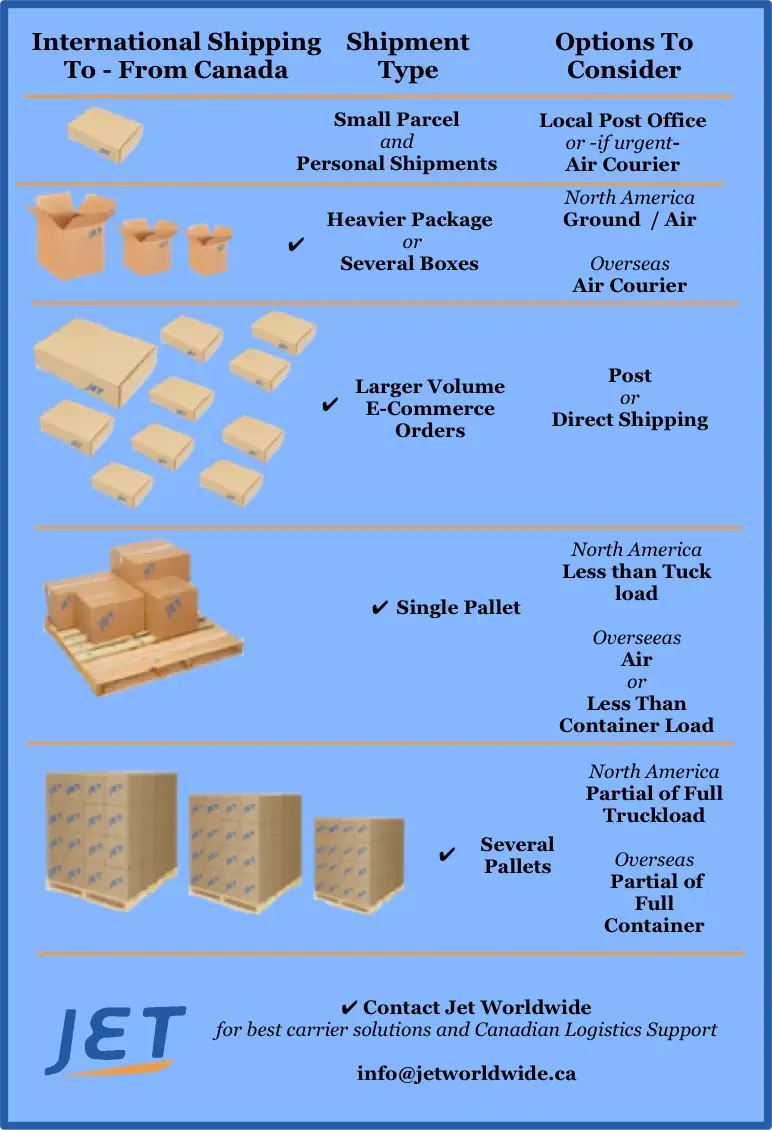
1. Individuals shipping Small Parcels: Canada Post
For shipping personal goods or low-weight e-commerce items, Canada Post remains the most economical choice. While tracking is often basic, the savings are significant for non-urgent shipments.
- Canada Post Packet: Best for items under 2kg (4 lbs).
- Canada Post Surface: Lowest cost for large items (Delivery: 1-2 months).
- Limitation: Canada Post does not offer robust Delivery Duty Paid (DDP) options for most destinations.
2. Global Courier Services: FedEx, UPS, and DHL
For businesses requiring speed and end-to-end visibility, the "Big Three" are the gold standard. These carriers are ideal for medium-sized shipments and time-sensitive commercial goods. Contact our team for a comparison rate for this type of service. We provide low cost spots for shipments as little as 20 kilograms.
Pro-Tip: Mega-carriers favor enterprise-level volume. If you are a small to medium business, working with a shipping reseller or partner can give you access to the same networks at significantly discounted rates with more personalized support.
3. High-Volume: Sea and Air Freight
- Ocean Freight (LCL/FCL): The most cost-effective for large commercial orders. Transit: 30-90 days.
- Air Freight: Best for high-value or time-critical commercial cargo.
- Freight Forwarders: Companies like Kuehne + Nagel or Jet Worldwide act as intermediaries to manage complex documentation and customs.
Customs & Export Regulations: What You Must Know
Shipping internationally involves more than just a label. Failure to comply with regulations can lead to seizures and heavy fines.
🇨🇦 Canadian Export Declaration (CERS)
Required for all goods valued over $2,000 CAD (or restricted goods of any value) to all non-USA destinations.
🌍 Destination Import Duties
The receiver (consignee) is generally responsible for duties and taxes. To avoid delivery delays, ensure you have clarified who pays (DDP vs. DAP) before the shipment leaves Canada.
Leveraging Canadian Free Trade Agreements (FTAs)
Canada has robust trade agreements, allowing for duty-free entry to all major markets with the notable exceptions being India and China. Read about Canada's free trade agreements. Your goods may qualify via:
| Agreement | Region |
|---|---|
| CUSMA / USMCA | USA and Mexico |
| CETA | European Union |
| CPTPP | Japan, Australia, NZ, Vietnam, etc. |
Note on De Minimus: Many countries have a "Low Value Threshold" where duty is not applied (e.g., $800 USD for the USA). Check the threshold for your specific destination to see if your shipment qualifies automatically.
Final Logistics Checklist
- Insurance: International carriers have limited liability. Always consider 3rd-party insurance for high-value items.
- Packaging: Use double-walled boxes. Remember that Chargeable Weight (dim weight) is calculated based on size vs. weight.
- Documentation: Ensure your Commercial Invoice clearly states the "Country of Origin" and "HS Code" to prevent customs delays.
Choosing the right shipping method requires balancing speed, cost, and reliability. Start by evaluating your package size and the urgency of the delivery.