
Finding the balance between "cheapest" and "fastest" is the eternal struggle of international logistics. Whether you are an e-commerce brand scaling globally or an individual sending a gift, the landscape of shipping from Canada has evolved.
You can use our free shipping rate request to get actual numbers, but first, you need to understand the strategy. Read below to learn how to pick the right carrier every time and discover "insider" methods like zone skipping.
The Landscape: Which Shipping Services are Available in Canada?
With demand for worldwide shipping on the rise, simply defaulting to the post office is no longer the only strategy. To optimize costs, you must match the service to the package profile.
Quick Summary: Who Wins on Price?
- Lightweight (Under 2kg) and Personal: Canada Post is usually the cheapest.
- Urgent and Tracked: FedEx, UPS, and DHL dominate but cost more.
- E-commerce Volume: Direct Injection (Zone Jumping) and consolidators offer the best value.
Option 1: Canada Post (The "Economy" Choice)
For individuals sending small packages and personal goods, Canada Post remains the baseline for "cheapest" shipping, specifically for items under 2kg (4.4 lbs).
Small Packet vs. Xpresspost
- International Small Packet (Surface or Air): This is the "no-frills" option. It is the most economical way to ship, but it comes with significant trade-offs: no tracking, no on-time guarantees, and long transit times (sometimes weeks via Surface).
- Xpresspost International: This bridges the gap between postal and courier. It includes tracking and faster delivery (1-3 weeks). Note that Xpresspost is handed off to local postal partners abroad (e.g., USPS in the USA, Royal Mail in the UK).
Warning on Duties: Shipments sent via standard mail are generally shipped "DDU" (Delivery Duty Unpaid). This means your receiver may be charged duties and taxes before they can collect the package.
Option 2: The Integrators (FedEx, UPS, DHL)
For reliability, heavier parcels, or urgent deadlines, the private carriers take the lead.
Comparing the Big Three
- FedEx and UPS: These giants dominate the North American lane (Canada to USA). They offer ground services that are very cost-effective for heavier boxes going south of the border.
- DHL Express: While smaller domestically in Canada, DHL is a powerhouse for international exports to Europe, Asia, and Africa. They often have superior reach in remote international zones.
The "Brokerage" Factor: Be aware that while UPS/FedEx Ground rates to the USA look cheap, they often trigger "entry preparation fees" (brokerage fees) that can shock your customer. Always calculate the landed cost.
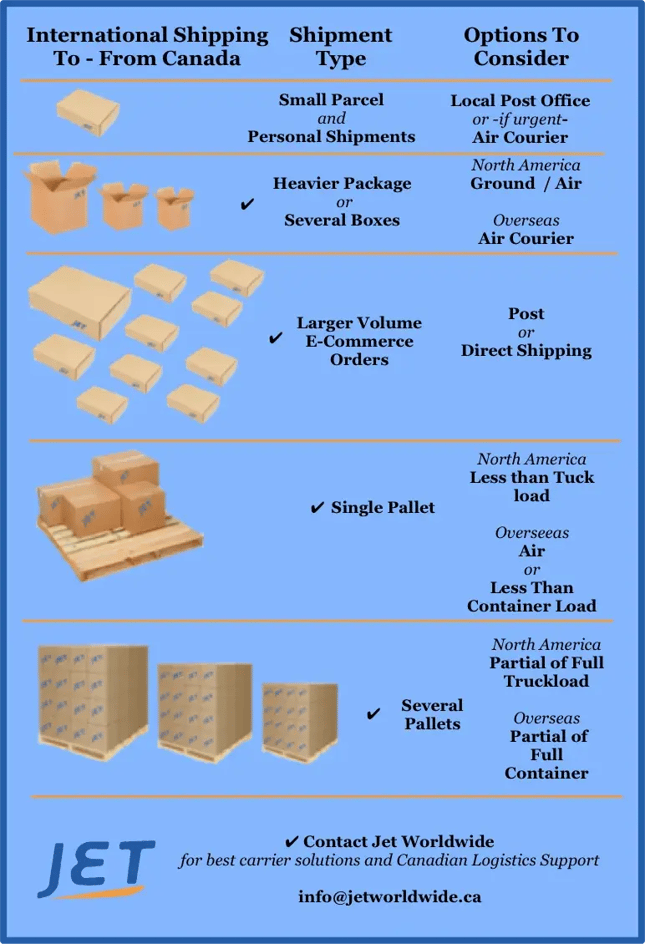
Option 3: Zone Jumping and Direct Injection (The "Pro" Choice)
If you are an e-commerce business shipping multiple orders a day, you should move beyond standard courier rates. The innovation here is Direct Injection (also known as Zone Jumping).
Instead of paying FedEx to fly 50 individual boxes to London, a consolidator (like Jet Worldwide) groups them onto a single pallet. This pallet is flown to the UK, cleared through customs in bulk, and then injected into the local domestic network (like Royal Mail or DPD).
Why Zone Jump?
- Lower Costs: You pay near-domestic rates for the final mile.
- Better Experience: You can clear customs prepaid (DDP), so your customer pays zero fees at the door.
- Scalability: It allows Canadian sellers to compete with local European sellers on price.
Critical Considerations Checklist
Choosing the carrier is only step one. To ensure your shipment actually arrives, you must master the paperwork.
Essential Shipping Resources


Innovations in 2026: What Google and Shoppers Value
Search engines now prioritize content that helps users make sustainable and data-driven decisions. Here is how modern shipping is changing:
1. AI-Driven Rate Shopping
Modern e-commerce platforms now utilize AI "Rate Shopping" algorithms. Instead of manually checking FedEx vs. UPS for every order, the software automatically selects the cheapest carrier that can still meet your delivery deadline. This automation saves an average of 15 percent on shipping spend.
2. Green Logistics and Carbon Offsets
Did you know that "Slow Shipping" is often "Green Shipping"? Selecting slower, surface-level options (like Ocean Freight or consolidated trucking) significantly reduces the carbon footprint per parcel. Google Shopping now highlights merchants who offer sustainable shipping options, potentially boosting your product visibility.
Summary: Transit Time Expectations
When planning your logistics, manage your customer's expectations with these general transit times from Canada:
- USA: 1 business day (Express) to 6 days (Ground)
- Europe: 2-3 days (Express) to 4-8 days (Direct Injection)
- Asia: 2-4 days (Express)
Ready to optimize your shipping mix?
Don't rely on a single carrier. Consult with our team to build a hybrid solution that blends speed, cost, and reliability.