
The Netherlands serves as a premier gateway to the European Union for Canadian businesses. As a leading European market, it is where Canadian companies send parcels, pallets and e-commerce orders that often go on to the rest of the EU. That makes it the place where getting customs right pays off the most.
Canadian companies rely heavily on cost-effective, dependable shipping from Canada to the Netherlands. This guide covers what it costs, which carrier to use, and how the EU's 2026 parcel rules change the bill at the door.
Quick answer
For small personal parcels, Canada Post is usually the cheapest way to ship to the Netherlands. Express couriers deliver in about 2 business days, from about CAD 168 for 5 kg. Since 1 July 2026, e-commerce parcels up to €150 pay a flat €3 duty per tariff category, plus 21 percent Dutch VAT.

Download our accompanying PDF guide, or get a spot quote between Canada and the Netherlands.
Canada and the Netherlands in numbers
CAD 8.6 billion
Two-way merchandise trade in 2020, including CAD 5.4 billion of Canadian exports
18.5 percent
Growth in that trade in 2020 compared with 2016, the year before CETA
21 percent
Dutch standard VAT, charged on imports along with any duty
The gateway label is earned. Rotterdam is Europe's largest seaport, Schiphol is one of its busiest air cargo hubs, and Dutch tax rules let licensed importers defer import VAT at the border (see Article 23 below). For a Canadian shipper, a parcel or pallet cleared in the Netherlands is in free circulation across the whole EU single market.
2026 update: duty and fees on low-value parcels
Until mid-2026, e-commerce parcels to Dutch and European consumers valued at €150 or less were exempt from customs duty (VAT has applied to every parcel since 2021). Since 1 July 2026, that exemption is gone: each parcel pays a flat €3 customs duty for each distinct item category in the box, based on tariff sub-headings.
Example calculation
- The order: 1 silk blouse, 2 wool blouses and 4 wool scarves. Value €140.
- The assessment: silk and wool blouses fall under different tariff sub-headings, and scarves are a different category again, so the box holds three distinct categories. The number of pieces does not matter.
- The duty: 3 categories x €3 = €9 total customs duty.
- The VAT: €29.40 at checkout if the seller uses IOSS (21 percent of €140), or €31.29 at import without IOSS (21 percent of €149, the value plus duty).
A separate EU customs handling fee comes next. The Commission's draft rules set it at €2 per e-commerce item, and Dutch Customs has confirmed it applies from 1 November 2026 to all e-commerce consignments, whatever their value. Ask your carrier how it will pass the fee on.
- 21 September 2017CETA provisionally applied: most Canadian-origin goods enter the EU duty-free.
- 1 July 2021EU removes the VAT exemption for small parcels and launches the Import One-Stop Shop (IOSS).
- 1 July 2026Flat €3 duty per tariff category on e-commerce parcels up to €150.
- 1 November 2026EU customs handling fee starts, €2 per e-commerce item under the draft rules.
- 1 July 2028Temporary €3 duty scheduled to end as the permanent EU customs regime arrives.
Product identifiers (PID) for B2C shipments to the Netherlands
Every shipment to a consumer (a business-to-consumer, or B2C, sale) must include product identifier (PID) information for each item, whatever the shipment's value.
PIDs do not apply to business-to-business (B2B) shipments sent to a VAT-registered business.
Shipping options: Canada to the Netherlands
Whether you are shipping a small parcel or a large commercial pallet, you have several dependable choices:
| Option | Typical transit | Best for |
|---|---|---|
| Express courier | Within 2-3 business days | Urgent parcels with full tracking |
| Economy courier | About 3 to 5 business days | Most commercial parcels; the best value for business |
| Air freight | Within 1 week,door to door | Heavier or high-value cargo, pallets |
| Ocean freight (LCL or FCL) | About 3 to 8 weeks, door to door | Several pallets, bulk commercial orders |
| Canada Post | Air 1 to 2 weeks; surface longer | Individuals sending small, lightweight personal items |
Shipping cargo via sea freight
The Netherlands is the logistics centre of Europe. For European service, Canadian cargo usually sails from Montreal or Halifax; the Pacific ports of Vancouver and Prince Rupert mainly serve Asian trade. On arrival, the Port of Rotterdam handles the bulk of container imports, with Amsterdam focused on bulk cargo and Antwerp-Bruges in neighbouring Belgium as the main alternative.
- LCL (less than container load): best for shipping one to several pallets by sharing container space.
- FCL (full container load): the fastest and most predictable ocean method, using a dedicated 20-foot or 40-foot container with no consolidation stops.
Air freight vs. ocean freight
Ocean freight often includes minimum charges at both ends. Because of this, shipping smaller consignments by air is often cheaper door to door. As a general rule, shipments under 100 kilograms are cheaper by air, while cargo over 500 kilograms is much cheaper by ocean. Between the two, get both quotes.
Each carrier option explained
- Canada Post: ideal for personal gifts. Canada Post parcels are handed over to PostNL for final delivery. Gifts sent from one private individual to another are free of duty and VAT up to €45; purchases are not gifts.
- FedEx, UPS and DHL: reliable express parcel delivery. These major carriers provide fast international priority air but can be expensive for small businesses at their published rates.
- Jet Worldwide: we partner with leading carriers and European agents to offer low-cost delivery for packages, pallets and e-commerce zone jumping.
Get our lowest spot quote for parcels over 10 kilograms and for commercial volumes.
Sample shipping prices and dimensional weight
Please note: these estimates are for guidance only. Final billed rates will vary based on fuel surcharges, exact dimensions, delivery address and your account discount level.
| Chargeable weight | Sample price CAD | |
|---|---|---|
| 5.0 kg | $170 | |
| 7.5 kg | $225 | |
| 10.0 kg | $245 | |
| 12.5 kg | $300 | |
| 15.0 kg | $340 |
Fuel surcharge has increased the costs. Get a quote with the most up to date pricing
Dimensional weight shipping calculator
Carriers charge on either the actual weight or the volumetric weight, whichever is greater. Volumetric weight is length x width x height in centimetres divided by 5,000, so a light 50 x 40 x 40 cm box weighing 4 kg is billed on 16 kg. Enter your dimensions below to estimate your chargeable weight and a sample price.
Dutch customs clearance for imports from Canada
Dutch Customs (Douane) applies the standard EU customs rules. Duty is charged on the customs value, which includes the cost of the goods plus freight and insurance to the EU border (CIF). Show freight and insurance on the commercial invoice: if they are missing, customs will estimate them, which can raise the duty and VAT assessment.
Taxes on imports to the Netherlands
- VAT: 21 percent standard rate, calculated on the CIF value plus any duty. A reduced rate of 9 percent applies to some essentials, such as food, books and medicines.
- Duty: set by the 10-digit EU tariff code and the same in every EU country. Rates can be high for textiles, some automotive parts and certain consumer goods.
- EORI: Dutch businesses importing from Canada need an EORI number (starting with NL). Private consumers do not.
- Canadian export side: shipments of CAD 2,000 or more need a CERS export declaration before leaving Canada.
To determine the exact duty rate, find your tariff classification in the European Commission's Combined Nomenclature (CN) and check the rate in the EU TARIC database. Learn more about tariff classification and HS codes.
Article 23: deferring import VAT
The Netherlands lets importers with an Article 23 licence report import VAT on their VAT return instead of paying it at the border. A business that can deduct VAT then pays nothing in cash on import. Non-EU companies usually need a Dutch fiscal representative to use it. This is a large part of why so many companies clear EU-bound goods in the Netherlands.
Jet Worldwide data
Many commercial shipments Jet Worldwide moved from Canada to the Netherlands cleared under the importer's Article 23 licence, so no import VAT was paid at the border.
Duty-free imports: CETA rules of origin
Under the Comprehensive Economic and Trade Agreement (CETA), the European Union and Canada benefit from a robust free trade agreement. Businesses can achieve duty-free import status for goods originating in Canada. The preference matters most for commercial shipments over €150, where normal duty rates apply.

To qualify for zero duty under CETA, the product must originate in Canada under the agreement's rules of origin, which usually means it was made or substantially transformed there. Simply buying an item in Canada and shipping it does not grant Canadian origin.
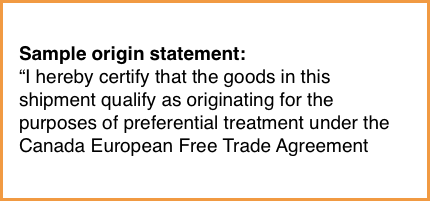
CETA does not require a formal certificate of origin. Canadian exporters make an origin statement on the invoice using the prescribed wording and their Canada Revenue Agency business number. The statement is what decides whether preferential duty-free import applies. Read more about certificates of origin.
Get a Canadian address to receive and ship goods
If you are using a package forwarding service to shop in North America, a Canadian address offers real advantages over US-based options like MyUS. It gives access to Canadian suppliers and, for goods made in Canada, a route to CETA duty-free treatment. Goods made elsewhere, including in the United States, do not become Canadian-origin by passing through a Canadian address.

Shipping personal effects to the Netherlands
To claim relief for personal effects from Canada, you apply to Dutch Customs for exemption from import duties for removal goods. Personal household goods can clear free of duty and VAT if you meet these conditions:
- You have lived outside the EU for at least 12 consecutive months.
- You are moving your normal residence from outside the EU to the Netherlands.
- You have owned and used the goods for at least 6 months before the move.
- The goods are imported within 12 months of taking up residence.
Items such as alcohol, tobacco, commercial materials, or items bought within the last 6 months do not qualify for this exemption. Download the personal effects form here.
Dry ice shipments for temperature control
Dry ice shipping provides a reliable solution for transporting temperature-controlled goods to the Netherlands, including biomedical samples, pharmaceuticals, life-science materials and perishable food samples. Solid carbon dioxide stays at about minus 78.5 °C and sublimates without leaving liquid residue.
Dry ice is a regulated dangerous good for air transport (UN 1845, Class 9). The box must let the gas vent, and the net weight of dry ice must be marked on the package and the air waybill.
Frequently asked questions
What is the cheapest way to ship from Canada to the Netherlands?
For small personal parcels under 2 kg, Canada Post surface options are generally the lowest cost. For commercial parcels, economy courier is usually the best value.
How long does shipping to the Netherlands take?
Express courier takes about 2-3 business days and economy courier about 3 to 5 business days. Canada Post air takes 1 to 2 weeks. Ocean freight takes about 3 to 6 weeks door to door.
Will I pay duty and VAT on a parcel to the Netherlands?
VAT of 21 percent applies to most imports. Since 1 July 2026, e-commerce parcels up to €150 also pay a flat €3 duty for each tariff category in the box. Above €150, normal duty rates apply, and CETA can remove duty on goods of Canadian origin.
Do I need an EORI number to import into the Netherlands?
Dutch businesses importing from Canada need an EORI number.
Are gifts to the Netherlands duty-free?
Gifts sent from one private individual to another are free of duty and VAT up to €45. Goods bought online are not gifts, even if sent as one.
Additional resources

Disclaimer: information in this post and all Jet Worldwide content is for general educational purposes only. Sample prices and calculator results are illustrative.