With the implementation of the CPTPP free trade agreement, Canadian companies are increasingly seeking new shipping solutions to and from New Zealand. This includes biological samples and shipments that require temperature control and remain chilled and/or frozen during transport.
This post provides a deeper dive and explores of the main elements of international temperature controlled shipping from Canada to New Zealand
Things to consider when shipping to New Zealand from Canada:
- New Zealand customs for goods shipped from Canada
- Shipping frozen goods via dry ice from Canada to New Zealand
- Carrier options for shipping New Zealand from Canada
Disclaimer: The information in all Jet Worldwide online content, including this post, is for general information only.


New Zealand Parcel Clearance for Shipments from Canada
Goods shipped to New Zealand must be accompanied by an invoice for customs or other supporting documents.
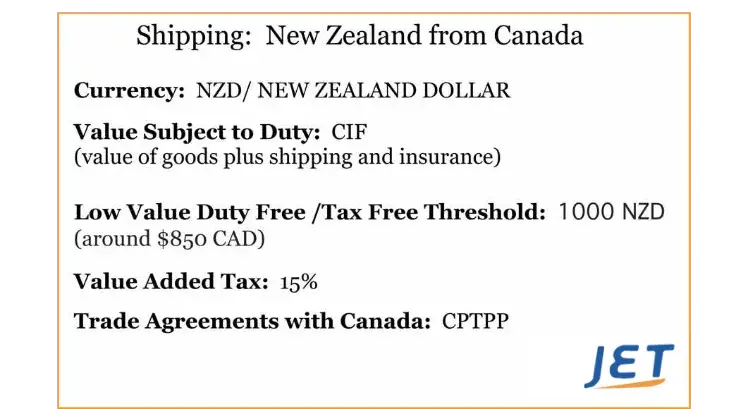
New Zealand customs duty and taxes on the applicable HS Code and the "CIF Value." The CIF value is the value of the item plus the cost of insurance and freight). The Goods and Service Tax (GST) of 15% is applied to all imported goods sent from Canada for import to New Zealand.
Duty rates in New Zealand can range from duty free for such things as most electronics and accessories to 10% for clothing an other fashion items.
The rate of duty payable is determined by the HS Code classification of the goods in the New Zealand Tariff, Most tariffs range from 0% to 10%. These duty rates apply mostly to clothing, footwear, and carpeting. Most computer software and hardware can be imported to New Zealand duty free.
When shipping goods with dry ice, it is very important to clarify and confirm the clearance process prior to shipping. Otherwise, clearance delays may cause the goods to no longer be chilled or frozen.
Duty Free importing of Canadian parcels to New Zealand
Most single parcels with a declared value less than $400 NZD (around $330 CAD) can be imported duty Free (but GST of 15% still applicable).
Information required by New Zealand Customs (and to be included on the commercial invoice) include:
- Shipper Address and contact details
- Importer details
- Details of the shipment: Item(s), value and reason for import
- Invoice Terms (FOB, CIF, etc.)
- If a multi-piece shipment, it must be noted what is each box
Usually good that ship with dry ice are not sensitive to import fees. But it is important that all the necessary details are present to minimize the likelihood of a potential delay.

Shipping Terms to Consider When Shipping to New Zealand
The default option for shipping internationally from Canada is Delivery Duty Unpaid (DDU). Common carriers use the term ExWorks (EXW) which essentially assigns all import related costs (duty, taxes, and other fees) to the receiver/ importer. Shippers from Canada can choose to pay the import fees on behalf of the receiver via a Delivery Duty Paid (DDP) options that many carriers offer. See our blog on IncoTerms and shipping terms for packages and online orders.
CPTPP Duty free clearance of goods shipped to New Zealand From Canada
Goods approved with proper “proof of origin’ supporting paperwork can be exported from Canada for duty free clearance in New Zealand.
 Benefiting from Canada' s Free Trade Agreements.
Proof of Origin
The key part of all trade agreements is ensuring the goods qualify under the rules of origin. Many incorrectly assume that if goods are sent from a qualifying country, they should qualify for duty free status. Country of origin is not determined solely by where the goods are sent from.
The country of origin rules have been simplified under CPTPP but can still get complex. The guidelines for country of origin qualification include:
- Goods are considered originating if they are wholly obtained, such as goods that are grown, raised, caught, or extracted in Canada/CPTPP country.
- Goods are considered originating if they are produced in Canada or a CPTPP country entirely from originating materials.
- Goods are originating if they are produced in Canada/CPTPP country from non-originating materials that undergo production in Canada/ CPTPP country, such that the resulting good satisfies the applicable product-specific rule of origin. The value of the non-originating goods that are part of the originating product can be considered dutiable.

Duty Free import for parcels sent from Canada to New Zealand under the CPTPP
The amazing part of CPTPP is that parcels containing products valued less than US$1000 (in local currency) do not require a certification of origin to claim CPTPP preferential tariff treatment.
Parcels containing products under US$1000 (in local currency) can be considered for duty free status if the following conditions include:
- A signed statement completed by the importer, exporter or producer certifying that the goods originated from a CPTPP country. This statement is required on the commercial invoice and we recommend adding an additional stand alone statement/ supporting document.
- The goods must meet the origin rules. For example, marks to indicate that the goods are not a product of a CPTPP country will disqualify the goods and have issues related to mis-declarations.
New Zealand origin goods shipped FROM New Zealand to Canada
Canadian companies can more easily take advantage of duty free clearance from New Zealand, a CPTPP Country.
Proof of origin requirements under Canada's free trade agreements
The value for duty amount for all of Canada's free trade agreements (including CPTPP) for which the proof of origin / certificate of origin is waived was changed to $3,300 CAD in July 2020. This change was made to harmonize the regulations with the new NAFTA/CUSMA.
For imports not exceeding $3,300 to Canada, the requirement for proof of origin is waived. The requirement on the importer to maintain records (for example, commercial invoice and B3) applies even if the CBSA does not require a certification of origin or if a requirement for a certification of origin has been waived.
DUTY FREE ≠ TAX FREE:
It is important to understand that CPTPP applies to duty assessments but not taxes. All goods - even those cleared duty free - are subject to taxes New Zealand taxes (including 15% GST).
Disclaimer: The information in this blog is for general information only. Producers, shippers, exporters, importers should confirm their processes with their customs brokers, carriers and regulating authorities.
Carrier Options for shipping temperature control to New Zealand from Canada
Shipping dry ice shipment to New Zealand via Canada Post is not possible
Shipping to New Zealand via UPS and FedEx Canada
FedEx and UPS are North Americas largest carriers and, along with DHL, offer the ability to ship dry ice within their networks.However, shippers must be approved and qualified under dangerous goods, regulations, and carrier policy.
Dry ice shipments to New Zealand the airfreight
Airfreight offers more direct options and more control over the routing. However, for small shipments, the airfreight minimum can be high. And even with transit via hubs, often courier can provide a faster overall transit time.
Shipping from Canada for delivery to New Zealand via Jet Worldwide
Jet Worldwide has been providing international cross border solutions for over 40 years to and from Canada. We have a global network of regional partners, options via global couriers, and specialized solutions.
Contact our team to build cold solutions from Canada.