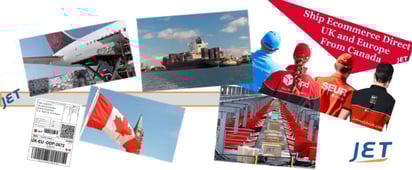
Canadian retailers are increasingly looking to grow their online sales to Europe. Sellers Canada can benefit by understanding B2C e-commerce rules to the EU.

Canada and the Great European Opportunity
Trans-Atlantic trade remains a major contributor to Canada's economy. Fulfillment direct from your Canadian place of business to Europe is a significant e-commerce growth opportunity. With a smart logistics process, you can bypass traditional postal delays and save meaningful cost.
Quick answer: To ship from Canada to Europe, classify your goods and add a CETA declaration of origin on the invoice so Canadian-made goods clear duty-free, then ship by courier, direct airfreight, or ocean. Clear customs once at any EU port and distribute across all member states. Contact our team for rates and support.
Quick takeaways for 2026
- CETA benefit: the Comprehensive Economic and Trade Agreement gives Canadian-origin goods duty-free import status to Europe.
- Direct injection: move beyond basic Canada Post options by injecting parcels directly into European networks such as DPD.
- Single market: clear customs once at any EU port of entry and distribute across all member states with no further customs formalities.
- Compliance: prepare for the 1 July 2026 EU customs changes for low-value parcels, and check CBAM, EUDR, and sanctions where relevant.
Download the accompanying PDF guide
What the EU Single Market Means for Your Shipments
The European Union is a single market with one common external tariff, which is the foundation of cost-efficient European distribution:
- One tariff applies to all goods imported into the EU, with consistent classification, valuation, and preferential-origin rules.
- Once goods are customs cleared at any EU port of entry, they can be distributed and sold in all member states with no further customs formalities.
- External-border checks for food safety, veterinary, and human health are uniform and carried out once on entry.
In practice it can still matter where goods enter the EU and from where you distribute, so plan the entry point and distribution model deliberately.
2026 EU customs reform
- The "deemed importer" for VAT is increasingly the e-commerce platform selling into the EU.
- A new EU Customs Authority, headquartered in Lille, will coordinate customs across member states.
- A European Union Customs Data Hub, from 2028, will provide an integrated platform to share customs data across authorities.
- A flat interim duty applies to low-value parcels up to 150 euro, charged per category of items in the consignment.
Building the Best European E-commerce Shipping Options
Cross-border e-commerce to Europe has three components: airlift, customs clearance, and last-mile delivery. The core challenge is classifying and clearing thousands of individual orders efficiently.
What is the cheapest way to send e-commerce to Europe?
Canada Post usually offers the lowest baseline price for individuals sending occasional packages, but it can be slow and is not ideal for scaling. Contact our team for our lowest spot quote on heavier parcels over 10 kilograms or for regular volume.
| Weight category | Canada Post service | Estimated cost (CAD) | Estimated speed |
|---|---|---|---|
| 1 kilogram (about 2 lb) | Air with tracking | 75 | 2 to 3 weeks |
| 2 kilograms (about 4 lb) | Air with tracking | 94 | 2 to 3 weeks |
| 4.5 kilograms (about 10 lb) | Air with tracking | 175 | 2 to 3 weeks |
Prices are estimates only, meant as a general guide.
Best shipping options to Europe from Canada
The best mode depends on the size and weight of your shipment and your overall volume:
- Individuals and occasional e-commerce: Canada Post.
- Heavier parcels and commercial shipments: FedEx, UPS, DHL.
- Palletized freight up to around 200 kg chargeable weight: air freight.
- Several pallets, containers, and bulk orders: ocean freight.
- High-volume B2C e-commerce: air-freight consolidation.
These are guidelines our team uses to determine your best options (request a quote).
How to reduce parcel delivery costs to Europe
To reach scale and fast delivery, consolidate packages and ship by direct airfreight from major Canadian hubs such as Montreal, Toronto, or Vancouver. Mega-carriers such as FedEx, UPS, and DHL offer strong recognition, but their retail delivery costs, even heavily discounted, often drive shopping-cart abandonment.
Can I connect directly with DPD from Canada?
Yes. Jet Worldwide helps you set up best-in-class processes to ship directly to European countries using local heroes such as DPD, Chronopost, and Seur. Via direct airfreight, DPD Classic reaches all major European destinations in 2 to 5 business days from Canada. This road-based European transport is time-definite and cost-effective.
Shipping dry ice? Our specialists can help you navigate the strict European customs requirements for shipping solid carbon dioxide (UN1845) from Canada to Europe.
2026 Update: EU Customs for Parcel Imports
New rules for parcels up to 150 euro
From 1 July 2026 the EU removed the 150 euro duty-free de minimis. A flat 3 euro duty for B2C parcel imports now applies, multiplied by each distinct item category (based on tariff sub-headings) in a single consignment.
Example calculation
An order containing 1 silk blouse and 3 wool blouses:
- The assessment: silk and wool have different tariff sub-headings, so there are two distinct categories in the box.
- The duty: 2 categories times 3 euro equals 6 euro total customs duty.
- The charge applies per unique HS code, per line on the declaration.
A separate handling fee of about 2 euro is expected to apply from around November 2026, though the amount and date are not yet finalized.
Per European Commission guidance, the 3 euro duty applies to each unique tariff classification, per declaration line:
- The 3 euro customs duty applies per declaration line irrespective of the quantity of articles on that line, provided the intrinsic value of all goods in the declaration does not exceed 150 euro.
- Practical takeaway: group multiple items that share the same tariff classification on a single declaration line, so the 3 euro duty is not applied more times than necessary.
Clarification noted: the 3 euro charge is a flat interim customs duty, effective 1 July 2026 with the removal of the 150 euro exemption, and interim until 1 July 2028, when the EU Customs Data Hub launches and normal tariff rates apply. Item-level Product Identifier Data becomes mandatory on 1 November 2026. See our 2026 update for B2C shipments to Europe and our PID guide.
VAT Rules, IOSS, and EU Distribution
All goods imported to the EU are subject to Value Added Tax (VAT). E-commerce shipments valued up to 150 euro should ideally be imported via the Import One-Stop Shop (IOSS). IOSS lets sellers and online marketplaces charge VAT at the point of sale and remit it directly to the authorities, giving a frictionless green-channel delivery.
Jet Worldwide provides IOSS solutions to facilitate registration and integrate seamless, low-cost shipping direct to all EU countries, with no surprise import charges for your consignee.
Why there is ultimately no net EU VAT burden
As with most EU businesses, Canadian exporters and EU distributors of Canadian goods do not pay net EU VAT, or are fully reimbursed for the VAT they owe. The ultimate EU VAT burden is effectively nil, and there is no difference in VAT status between goods originating in the EU and in Canada. The mechanism works like this:
1. Origin: CanadaGoods dispatched from your Canadian facility for distribution into Europe.
to
2. Any EU port of entryCustoms clearance with import VAT deferred. No cash VAT at the border; it is reported on the periodic VAT return, netting to nil.
to
3. Destination marketsB2B cross-border supply within the EU at 0 percent with the reverse charge; B2C VAT collected from the consumer, often via IOSS; non-EU destinations such as Switzerland treated as a 0 percent export.
Many EU member states offer import VAT deferment or postponed accounting, so import VAT is declared and reimbursed in the same return rather than paid in cash. Member states differ in how import VAT is settled and reported, which is one reason the entry point matters.
HS codes and European classification
The EU classification system is strict. It relies on the Harmonized System (up to 6 digits), the Combined Nomenclature for EU-specific codes (8 digits), and the TARIC system for specific tariff measures. Accurate classification is critical to avoiding delays and unexpected category-multiplier duties.
Best Practices for EU Market Entry
Beyond moving the parcels, a few structural decisions make European distribution smoother and cheaper:
- Create a central point of entry in the EU. A single, consistent clearance and injection point simplifies operations and reporting.
- Decide your role: importer or distributor. Consider whether, as a Canadian company, you act as the importer and supplier in the EU, or work through an EU-based party such as a distributor. The Incoterms you agree determine who carries the import obligations.
- Engage a competent customs broker (contact Jet).
- Arrange VAT representation. With no EU-established business, you can appoint a VAT fiscal representative or obtain the VAT permits that enable import VAT deferment, keeping your net VAT burden at nil.
- Seek confirmation when in doubt. On trade, customs, VAT, or regulatory questions, request a ruling or confirmation from the authorities rather than operating without clarity.
Some Canadian companies go further and establish an EU presence. Canada holds tax treaties with EU member states that reduce taxes and prevent double taxation, many member states offer advance customs and tax rulings, entity setup is often straightforward, and it is generally possible to operate through a branch of a Canadian legal entity, frequently with English-language contracting and dispute resolution.
CETA Duty-Free Clearance for Canada-Origin Goods
Simplified processes give Canadian companies easier EU access. If your goods are made in Canada, CETA can clear your e-commerce orders duty-free. Read more about Canada's free trade agreements.
CETA does not require a formal certificate to obtain tariff benefits: a specific declaration of origin written directly on the commercial invoice is usually sufficient. Origin means where the goods were made, not simply where they ship from.
Managing UK versus EU distribution
E-commerce sellers now face two distinct parcel flows, one to the United Kingdom and another to mainland Europe.
- The UK market: UK orders benefit from the UK-Canada Trade Continuity Agreement, which continued CETA benefits following Brexit.
- The EU market: shippers often rely on a European warehouse or injection hub, such as our Paris location, to distribute cost-effectively across France, Germany, Spain, Italy, Belgium, and beyond.
Canadian and US e-commerce shippers now rely on two separate parcel injection points. Jet Worldwide has direct solutions to both regions, letting you prepay VAT and duty with no charges forwarded to your European or British customers.
Product Compliance and 2026 Regulatory Regimes
Customs clearance is only part of the picture. Different EU and national rules may apply to the goods themselves, with EU legislation in the lead, and they must be met in the country where the products are offered to consumers. Identify your obligations before supplies begin, and consider whether repackaging, labelling, or stickering at a warehouse, after customs clearance but before the goods reach the market, is needed.
Product labelling
- Many products must bear CE marking, showing they meet EU requirements, for example on ingredients, machinery standards, or toy standards.
- Electrical appliances need an energy label and the WEEE label for separate collection, recovery, and recycling.
- Other labelling applies to footwear, textiles, toys, food, and eco-label categories.
- For food sold by a non-EU supplier, the name and contact details of the business responsible for the food information must be on the label; if that operator is not established in the EU, the EU importer should appear on the label.
- EU rules apply across the board, but member states may set additional requirements, such as the label language.
Key EU regimes to check in 2026
CBAM (Carbon Border Adjustment Mechanism)
The EU's carbon-pricing tool. The definitive regime, including certificate costs, applies from 1 January 2026 across six sectors: cement, aluminum, fertilizers, iron and steel, hydrogen, and electricity. The levy is not fixed; it tracks the EU Emissions Trading System allowance price. Importers over the 50-tonne annual threshold must become authorised CBAM declarants, and should coordinate the burden between supplier and customer.
EUDR (EU Deforestation Regulation)
Requires that products placed on the EU market do not contribute to deforestation. In scope: cattle, cocoa, coffee, palm oil, rubber, soya, and wood, plus certain derived products. Under Regulation (EU) 2025/2650, it applies from 30 December 2026 for large and medium operators, and 30 June 2027 for micro and small operators.
EU sanctions on Russia and Belarus
Comprehensive sanctions have been in force since early 2022, with many further packages since. They apply to EU businesses and persons and to business done in or via the EU, including bans on supplying many goods, where the origin of the goods is not decisive. Ensure compliance for any interaction with Russia or Belarus that has an EU link.
Anti-dumping and anti-subsidy
EU investigations are growing, for example in metals, chemicals, bicycles, electric cars, and robotic lawn mowers. Goods supplied from Canada are generally not subject, but it cannot be ruled out, particularly where goods shipped from Canada actually originate (non-preferential origin) in another jurisdiction such as China. Another reason genuine Canadian origin matters for CETA claims.
Operational insight from Jet Worldwide: in our experience, the biggest avoidable cost on Canada-to-Europe e-commerce is not the freight; it is fragmented declarations that multiply the 3 euro duty, plus VAT collected twice because IOSS was not set up. Consolidating orders, grouping identical items on one declaration line, and clearing through a single EU entry point with import VAT deferment usually does more for landed cost than switching carriers. On our EU lane we typically see a landed-cost saving of about
[JET-PROPRIETARY-PERCENT]% from consolidation.
(Placeholder: insert a real Jet figure before publishing.)
Frequently Asked Questions
What is the cheapest way to ship e-commerce from Canada to Europe?
For occasional individual parcels, Canada Post offers the lowest baseline price but is slow. For scaling businesses, the lowest landed cost comes from consolidating orders and shipping by direct airfreight into European networks such as DPD, Chronopost, or Seur, reaching most of Europe in 2 to 5 business days.
Can I ship duty-free from Canada to Europe under CETA?
Yes, for Canadian-origin goods. Under CETA, goods made in Canada enter the EU duty-free with a declaration of origin on the commercial invoice, and no formal certificate is required. The buyer still pays import VAT. The UK-Canada Trade Continuity Agreement gives similar duty-free access to the UK.
How does the 2026 EU 3 euro customs duty work?
From 1 July 2026 the EU removed the 150 euro duty-free de minimis, and a flat 3 euro duty applies per declaration line, irrespective of the number of articles on that line, provided the intrinsic value of the consignment does not exceed 150 euro. Multiple identical items on one line attract a single 3 euro charge, while different tariff categories each attract their own. The measure is interim until the EU Customs Data Hub launches on 1 July 2028.
Do I need to pay EU import VAT when distributing from Canada?
In practice the net EU VAT burden for business-to-business shipments is nil. Many member states offer import VAT deferment, so import VAT is reported on the periodic return rather than paid in cash. Onward cross-border B2B supplies are charged at 0 percent with the reverse charge, and B2C VAT is collected from the consumer, often via IOSS.
Can I clear customs at one EU port and sell across all of Europe?
Yes. The EU is a single market with one common external tariff. Once goods are cleared at any EU port of entry, they can be distributed and sold in all member states without further customs formalities. The choice of entry point can still affect cost and efficiency.
What is the difference between shipping to the UK and to the EU?
Since Brexit the UK is a separate customs territory. UK orders use the UK-Canada Trade Continuity Agreement, which carries CETA-style preferences forward, while EU orders rely on CETA and often a European injection hub. Sellers manage two distinct parcel flows.
Do CBAM, EUDR, and EU sanctions affect Canadian shippers?
It depends on the goods. The CBAM definitive regime applies from 1 January 2026 to importers of cement, aluminum, fertilizers, iron and steel, hydrogen, and electricity. EUDR applies from 30 December 2026 for large and medium operators and covers cattle, cocoa, coffee, palm oil, rubber, soya, and wood. Sanctions apply to business done in or via the EU. Most typical e-commerce parcels fall outside CBAM and EUDR, but the rules should be checked before goods are placed on the market.
Expand Your Offer to the European Market
Jet Worldwide acts on behalf of your team, offering transparency, logistics expertise, and high-level industry contacts. We make it easy to get spot quotes for economy air shipping between Canada, the USA, the European Union, and the UK.