A common question from shippers in the USA is whether they have to pay duties on items shipping to Canada. We hear it more often as e-commerce sellers in the USA ship orders to their Canadian customers. Below are the common questions on import fees to Canada for shipments from the USA, updated for the new Canadian counter-tariffs on US goods.
Quick answer
Do you pay import fees shipping from the USA to Canada?
Shipping from the USA to Canada, you may owe duty, GST or HST, a ground entry-preparation fee, and a carrier disbursement charge. US-origin goods qualify duty-free under CUSMA rules of origin; goods made elsewhere do not (even if shipping from the USA). From September 8, 2026, Canadian counter-tariffs of 15, 25, or 50 percent hit listed US-origin goods.
Key takeaways
- Import fees are more than duty: budget duty, GST or HST, a ground entry fee, and a carrier disbursement charge.
- Origin decides duty: only goods made in the USA qualify duty-free under CUSMA; goods made in Asia and sold from a US site do not.
- New for 2026: from September 8, 2026, Canadian counter-tariffs of 15, 25, or 50 percent apply to listed US-origin goods.
- CARM is mandatory: importers must register in the CBSA CARM Client Portal and post security.
Import fees to Canada: duty, tax, and customs explained
It is important to understand that duty is just one part of the import fees to Canada. Total import fees to Canada can include:
- Duty
- plus provincial and federal sales tax
- plus an entry fee (for ground shipments)
- plus a carrier disbursement or administrative charge
- plus, for listed US-origin goods, a Canadian counter-tariff surtax from September 8, 2026 (see next section)
Why does duty apply when the USA and Canada have free trade?
All shipments between the USA and Canada are subject to duty. The most favoured nation (MFN) rate is the default. Only goods that qualify as originating in the USA under the rules of origin of the USMCA (CUSMA) free trade agreement can qualify for preferential duty-free import. See the rules of origin section below.
Read more: understanding duty and calculation.
New Canadian counter-tariffs on US goods (Section 338 response)
What changed, and why it matters for US to Canada shipments
The United States placed new Section 338 tariffs on select Canadian goods. Canada is responding with matching counter-tariffs on US-origin goods. If you ship US-origin products in the listed sectors to Canada, budget a surtax of 15, 25, or 50 percent on top of any normal duty from September 8, 2026.
Here is the decision timeline behind the change:
- The US signs three Section 338 proclamations placing an additional 50 percent duty on specific Canadian dairy, alcoholic beverages, and motor vehicles.
- After a three-day suspension from the original August 19 date, the US Section 338 tariffs take effect at 12:01 a.m. Eastern time. They apply even to CUSMA-qualifying goods and are based on where goods are made, not where they ship from.
- Canada suspends trade negotiations and announces dollar-for-dollar countermeasures on about CA 27.6 billion of US goods, plus a CA 7.5 billion support package for affected workers and businesses.
- Canada imposes counter-tariffs of 15, 25, and 50 percent on US-origin products, with each product rate matching the corresponding US rate.
| Feature | Detail |
|---|---|
| Effective date | September 8, 2026 |
| Rate tiers | 15, 25, and 50 percent, matching the US rate for the same goods |
| Coverage | About CA 27.6 billion in US imports |
| Focus sectors | Steel, dairy, appliances, agricultural equipment, pulp and paper, and electronics |
| Consumer examples reported | Makeup, smartphones, and kitchen appliances |
| Excluded | Energy and potash |
| Applies to | US-origin goods, based on where the goods are made |
What US shippers should do now:
- Confirm HS exposure. Check whether your products fall in the listed sectors and match them to the official product schedule before you quote landed cost.
- Re-run landed cost. For affected goods, add the 15, 25, or 50 percent surtax on top of MFN duty, then apply GST or HST.
- Check origin, not shipping point. The surtax follows US country of origin, so goods you re-export through the US may or may not be caught depending on where they were made.
Fast-moving file: this section is current as of August 27, 2026. Rates, dates, and the line-by-line product list can change. Confirm your specific HS classifications against the official Canadian schedule and with your customs broker before you ship or quote.
Entry preparation fees from FedEx and UPS
Shipments importing via UPS ground are subject to an entry preparation fee. The same is true for shipments via FedEx ground. This can be a significant fee and often offsets the savings of ground versus express.
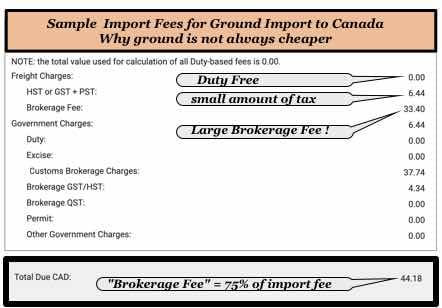
UPS and FedEx charge an entry preparation fee for expedited and ground shipments to Canada. See FedEx and UPS entry preparation fees (2026 PDF).
Partner with Jet Worldwide
Our experts provide personalized support to ensure your shipments are classified correctly and delivered on time, with compliance.
Request a quote Talk to an expertCanadian sales tax for imports from the USA
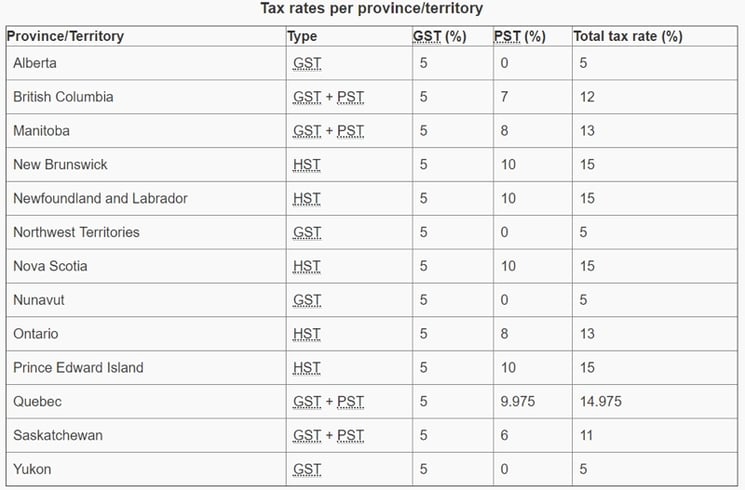
Canada's sales tax is better understood as a value-added tax, meaning it applies at each stage of production and distribution, but the final consumer bears the burden. Keep in mind that some businesses can claim back the sales tax paid on imported goods.
The Canadian sales tax system has two main taxes:
- Goods and Services Tax (GST): national sales tax of 5 percent.
- Provincial Sales Tax (PST): averaging between 6 and 10 percent.
- Harmonized Sales Tax (HST): a combination of GST and PST that applies to shipments to Ontario, New Brunswick, Newfoundland and Labrador, Nova Scotia, and Prince Edward Island.
Rules of origin: why goods from the USA may not be US origin
The rules of origin under the USMCA (CUSMA) free trade agreement apply to goods that are manufactured, grown (agriculture), or raised (beef, chicken, pork, and so on) in the USA. Most e-commerce shipments from the USA to Canada are made elsewhere, usually in Asia or China. As such, they do not qualify for preferential duty-free import under USMCA (CUSMA) country of origin rules.
Read more: certificate of origin and why it is necessary.
Common example: an item made in China and sold from a US online site to a Canadian buyer is not eligible for preferential duty-free import under USMCA (CUSMA) rules of origin. It can still import duty-free if under CA 150 in value (see the de minimis section).
Do Alibaba, AliExpress, Shein, Temu, and eBay get duty-free import to Canada?
No: e-commerce imports from China are subject to the same import processes as shipments from anywhere else. In fact, shipments from the USA via courier can benefit from a higher duty-free threshold (read more about de minimis values).
Yes, in practice: e-commerce imports from China are huge volumes for Canada Post. While technically subject to the same regulations, they often clear with less oversight. Many import under the CA 20 postal duty-free threshold regardless of the actual order value. Read more about declared value for international shipping.
Low-value duty-free import and de minimis thresholds
Yes, most courier consignments up to CA 150 in value (around US 120) can qualify for duty-free import. Once the value is over CA 40, federal and provincial taxes apply. Postal shipments have a lower CA 20 threshold.
| Courier shipment value | Duty | Tax (GST, PST, or HST) |
|---|---|---|
| Under CA 40 | Duty-free | Tax-free |
| CA 40 to CA 150 | Duty-free | Tax applies |
| Over CA 150 | Duty applies unless CUSMA-qualifying | Tax applies |
Useful reading: realizing the benefit of low-value duty-free thresholds.
Carrier disbursement fees
The common carriers to Canada from the USA, namely FedEx and UPS, pay Canadian customs import fees at the time of import. Carriers then assess a charge on the amount they advanced for duty and tax. The charge is usually around 3 percent of the duty and taxes.
In most cases for online orders, a minimum charge of around CA 10 applies. A carrier minimum disbursement fee can have a relatively big impact on e-commerce orders.
Why import fees to Canada can seem inconsistent
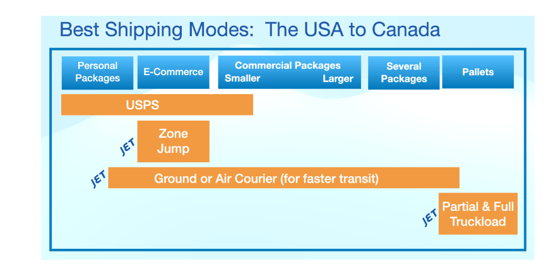
The inconsistent application of import fees is often the result of shipping via USPS (Canada Post) versus a commercial carrier. Generally, shipments via USPS seem less likely to be charged import fees. While the rules of import are the same, there appears to be a clearance advantage via Canada Post versus commercial imports.
While there are no numbers readily available to validate the claim of easier postal clearance to Canada, there is plenty of anecdotal evidence.
How to lower your Canadian import fees
There are strategies to help lower import fees to Canada that can involve specific items, necessary volumes, and correct application of HS codes (read more about HS codes).
Contact our team (form below) for Canadian logistics solutions, a Canadian address for your returns, and Canadian warehousing and distribution. Businesses can request a call back for logistics support.
Other things to consider when shipping to Canada from the USA
- Importer of record: the importer of record must obtain an importer number. For direct-to-consumer orders, the consumer can be the importer of record.
- Tariff classification for all imports (read more about HS codes).
- Provincial licenses may be necessary even when selling direct to consumers.
- Health Canada approvals for regulated goods.
- Safe Food for Canadians certifications for some food items.
- Federal and provincial sales taxes (see the sales tax section above).
- Country of origin declaration is necessary for all imports.
- Valuation is an important part of the declaration to the CBSA (read more about valuation).
- Labeling for goods to Canada may require both French and English.
- Certification of origin for duty-free import via CUSMA.
Read more: non-tariff costs for international shipments.
CARM, CERS, and export declarations
Canada Border Services Agency Assessment and Revenue Management (CARM)
The CARM system facilitates payment of duty and taxes. Registration is mandatory. Using this CBSA portal, importers assign a customs broker and post a surety bond or deposit. Learn more about CARM.
Export declarations for shipments to Canada
US Foreign Trade Regulations (FTR) mandate that export declarations be filed via the Automated Export System (AES), formerly the Shipper's Export Declaration (SED). Electronic Export Information (EEI) provides statistical data collection and helps enforce export regulations.
EEI filings are not necessary for most shipments to Canada. The exemption code is 30.36. The exemption does not apply where a shipment otherwise requires an export permit or is ultimately destined for a third country.
What is the difference between CARM and CERS?
| System | Direction | When it applies |
|---|---|---|
| CERS (Canadian Export Reporting System) | Exports from Canada | Shipments above CA 2,000 or otherwise restricted require an export declaration. |
| CARM (CBSA Assessment and Revenue Management) | Imports to Canada | All importers must register in CARM; an importer ID and security deposit are required. |

Download the accompanying PDF guide.
Frequently asked questions
Do I pay duty shipping from the USA to Canada if there is free trade?
All shipments between the USA and Canada are subject to duty, and the most favoured nation (MFN) rate is the default. Only goods that qualify as originating in the USA under CUSMA rules of origin can import duty-free. Goods made elsewhere, for example in China but sold from a US site, do not qualify even though they ship from the USA.
What are the new Canadian counter-tariffs on US goods?
Effective September 8, 2026, Canada imposes counter-tariffs of 15, 25, and 50 percent on US-origin products drawn from those targeted by US Section 338 and Section 232 tariffs, with each product rate matching the corresponding US rate. The measures cover about CA 27.6 billion in US imports and focus on steel, dairy, appliances, agricultural equipment, pulp and paper, and electronics. Energy and potash are excluded.
What is the entry preparation fee to Canada?
FedEx and UPS charge an entry preparation fee on expedited and ground shipments to Canada. It can be significant and often offsets the savings of ground versus express service.
Can a low-value shipment import duty-free to Canada from the USA?
Yes. Most courier consignments up to CA 150 in value (around US 120) can import duty-free. Once the value is over CA 40, federal and provincial taxes apply. Postal shipments have a lower CA 20 threshold.
What is a carrier disbursement fee?
When FedEx or UPS advance duty and tax to Canadian customs at the time of import, they assess a disbursement charge on the amount advanced. It is usually around 3 percent of the duty and taxes, with a minimum of around CA 10, which has a large impact on low-value e-commerce orders.
Is CARM registration mandatory to import into Canada?
Yes. Importers must register in the CBSA CARM Client Portal, obtain an importer number, assign a customs broker, and post financial security through a surety bond or deposit to pay duty and taxes.

Timothy Byrnes - Jet Worldwide
Timothy Byrnes owns and has led Jet Worldwide, a Montreal-based international logistics and customs brokerage firm, since 1988, specializing in North American cross-border shipping and trade compliance. More about our team.

Disclaimer: the information in Jet Worldwide online content is for general information only. Tariff rates and effective dates are changing quickly in 2026. Always confirm compliance and current rates with customs authorities or your broker prior to shipping.