HM Customs (HMRC) has increased enforcement of declared values for parcels shipped from Canada. Accurate value declarations are required for all imports, whether commercial or personal. Incorrect or unsupported values can cause clearance delays, fines, or reassessments — and a single underdeclaration can flag every future shipment from the same exporter.
At Jet Worldwide, we advise Canadian shippers to keep supporting documents (invoices, receipts, export declarations) to validate declared values. Our team works closely with HM Customs and carrier partners to ensure compliance and minimise risks.
In this post, we explain UK declared value rules, CIF valuation, the Canada-UK free trade agreement (CUKTCA), VAT collection for e-commerce, and best practices for Canadian exporters — plus a real-world case study showing how a £25,000 invoice became a £29,200 customs value.
The 3 Elements That Determine UK Import Duty
- Declared Value (the focus of this guide)
- Origin of Goods (rules of origin, free trade agreements)
- Customs Tariff Classification (HS Code)
Declared Value and the UK Free Trade Agreement
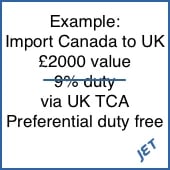
Canada and the UK maintain two free trade agreements under the Canada-UK Trade Continuity Agreement (CUKTCA) and CPTPP. CUKTCA and CPTPP provide duty-free access for qualifying goods, but only when:
- A correct certificate of origin is supplied
- The declared value is accurate and documented
- READ MORE: CUKTCA VS CPTPP
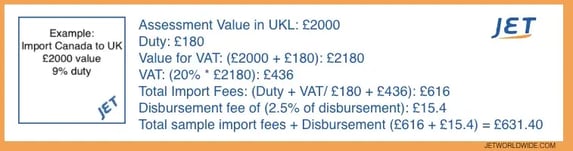
Keep in mind that "duty free" does not mean free of import fees such as VAT, and brokerage and disbursement.
Explore Canada's Free Trade Agreements
Understanding Declared Value Methods
1. Transaction Value (Most Common)
The price actually paid or payable for the goods, adjusted to include shipping and insurance where applicable. Example:
- Goods cost: CAD 1,000
- Shipping plus insurance: CAD 290
- Declared value = CAD 1,290
2. Alternative Methods (if no transaction value applies)
- Value of identical goods
- Value of similar goods
- Deductive value method
- Computed value method
- Fallback method
What Is CIF Value?
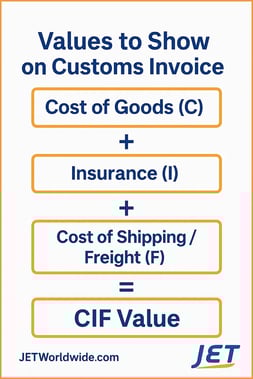
CIF means Cost plus Insurance plus Freight. HM Customs assesses duty and VAT based on CIF value.
Example: A CAD 1,000 good with CAD 200 freight plus CAD 50 insurance gives a CIF value of CAD 1,250.
Read more: CIF Valuation Explained
Case Study: The £25,000 Invoice That Became £29,200
When the Invoice Is Not the Whole Customs Value
A UK importer ordered custom aluminium profiles from a Canadian extrusion plant. The shipment value: £25,000. The customs declaration showed £25,000.
HM Customs stopped the shipment at Felixstowe.
The query was not about the goods. It was about what else should have been on the invoice.
The Canadian manufacturer had charged the buyer separately, in earlier transactions, for design work, tooling, and prototype samples. Those costs totalled £4,200. Under HMRC valuation rules, design and development costs borne by the buyer must be added to the transaction value when they relate to the imported goods — even if they were paid months earlier on a separate invoice and considered closed business.
The importer had treated those fees as finished and unrelated. HM Customs did not.
HMRC assessed additional VAT on the £4,200 difference, plus issued a compliance notice flagging future shipments for closer review.
The lesson: The invoice amount is the starting point for customs value, not the finish line.
What Else Belongs in the Declared Value: The Assists Rule
Tooling charges, engineering and design fees, royalties and licence payments, and buyer-supplied materials all adjust the declared value when they are connected to the goods being imported. In customs terminology these are called "assists". Pay them on a separate invoice, in a separate transaction, in a separate currency, or even in a separate calendar year — none of that changes the rule. If the cost contributed to the production of the imported goods, and the buyer bore it, it forms part of the customs value.
The transaction value is adjusted upward by:
| Adjustment Category | What It Includes |
|---|---|
| Buyer commissions and brokerage | Selling commissions paid by the buyer (excluding buying commissions) |
| Containers and packing | Cost of containers and packing materials integral to the shipment |
| Assists | Materials, components, tools, dies, moulds, engineering, design, artwork, or development work supplied by the buyer free of charge or at reduced cost |
| Royalties and licence fees | Payments the buyer is required to make as a condition of the sale |
| Resale proceeds | Any portion of subsequent resale proceeds that accrues to the seller |
| Transport and insurance | Costs to the place of importation (HMRC requires CIF basis) |
Assists are the category that catches importers most often. Design work paid to the seller in an earlier transaction, moulds the buyer purchased and provided to the manufacturer, raw materials the buyer shipped to the foreign factory for incorporation into the finished goods — all of these are buyer-funded contributions to the value of the imported product, and all of them must be apportioned across the units they relate to and added to the declared value at entry.
Declared Value for E-Commerce Orders (VAT)
UK's Value added Tax (VAT) applies to the value of the importing goods plus applicable duty. Note that businesses can often claim back VAT. It is often a larger issue as it relates to shipments to individuals including online sales.
Government guidance on VAT for online sales
Brokerage and Carrier Fees for UK Imports
Beyond basic duty and VAT, importers should be aware of fees for customs brokerage and prepayment of import fees. The prepayment of import fees is a commonly referred to as a "disbursement fee" by the carriers.
Other fees to consider include storage (which can be exorbitant for even short term storage), port fees, entry preparation, and a customs bond.
Compliance Checklist for Canadian Shippers
- Keep all invoices and proof of payment
- Declare CIF value (goods plus insurance plus freight)
- Add buyer-paid assists (design, tooling, royalties, supplied materials)
- Use correct HS codes (see HS Codes guide)
- Include UK VAT registration for B2B shipments where applicable
- Verify whether goods qualify for duty-free import under CUKTCA and supply a certificate of origin
- Use clear Incoterms (DDP, DAP, or DDU) to define duty and VAT responsibility

FAQs: Declared Value for UK Imports
What happens if I under-declare the value of goods to the UK?
HM Customs can reassess the value, delay clearance, impose penalties, or seize the goods. A reassessment also flags future shipments from the same exporter for closer review, which can slow every subsequent delivery.
Does the declared value include shipping?
Yes. HM Customs requires CIF value (Cost plus Insurance plus Freight), not just the cost of the goods themselves.
Do online sellers have to pay VAT on shipments under 135 GBP?
Yes. Online platforms must collect VAT at checkout for orders at or below 135 GBP shipped to UK customers.
Do design fees, tooling, or royalties need to be added to the customs value?
Yes. Under HMRC valuation rules, buyer-paid costs known as assists (design work, tooling, moulds, royalties, licence fees, and buyer-supplied materials) must be added to the transaction value when they relate to the imported goods, even if invoiced separately months earlier. Failure to declare assists is one of the most common reasons HM Customs reassesses a Canadian shipment.
Are Canadian-origin goods duty-free in the UK?
Goods that meet the rules of origin under the Canada-UK Trade Continuity Agreement (CUKTCA) qualify for duty-free entry, provided a valid certificate of origin is supplied. VAT is still applied to the CIF value at entry.
Shipping Between Canada and the UK with Jet Worldwide
- Parcel, pallet, and e-commerce shipping solutions
- Low-cost tracked options for UK-bound orders
- Expert advice on customs, VAT, and free trade agreements
- Pre-shipment value reviews to catch assists, royalties, and other adjustments before they trigger HM Customs queries

· 8 minute read · By the Jet Worldwide Customs Team