
Belgium is a strategic entry point to the European Union, offering efficient access to Central Europe through a highly developed transportation network. Many trans-European carriers operate in and around Belgium, making it an effective hub for parcel, freight, and specialized logistics—especially for time-sensitive and high-compliance shipments.
Belgium’s major import categories include machinery, pharmaceuticals, and transport equipment. For Canadian exporters, that mix often translates into shipments requiring tighter handling controls, predictable transit times, and, in many cases, validated temperature-management practices across the shipping lane.
 Expand your cross-border transportation and logistics options—including temperature-controlled delivery.
Grow your understanding of cross-border shipping with a company providing logistics solutions for over 40 years. Whether you ship occasionally or manage recurring commercial lanes, our team can help you select the right service level, documentation approach, and packaging strategy. Contact our team for an initial consultation.
When Temperature Control and Dry Ice Shipping Matters
Some shipments cannot tolerate temperature excursions. In practice, that often means designing transport around a specific thermal profile—ambient, chilled, frozen, or deep-frozen. Dry ice (solid CO₂) is frequently used for frozen and deep-frozen profiles because it maintains very low temperatures and sublimates (transitions from solid to gas) without liquid residue.
Common applications for temperature-controlled shipments to Belgium
- Pharmaceuticals and life sciences: clinical trial materials, diagnostic samples, lab reagents, and temperature-sensitive APIs.
- Biotech and research: enzymes, test kits, and other cold-chain materials requiring frozen or deep-frozen transport.
- Specialty food and perishables: frozen seafood, premium meats, and high-value food items requiring frozen transit.
- Industrial materials: certain chemicals and specialty inputs that degrade outside specified temperature ranges.
Dry ice shipments: core handling considerations
- Safety and compliance: dry ice is regulated for air transport and must be declared, labeled, and packaged correctly.
- Ventilation: packaging must allow CO₂ gas to vent to avoid pressure build-up.
- Transit planning: dry ice quantity must align with route time, handling steps, and expected dwell time.
- Documentation discipline: commercial invoice and airwaybill details must match declared contents and handling requirements.
Shipping Guide: Canada to Belgium (Parcel, Freight, E-commerce, and Controlled Temperature)
- Delivery carrier options for shipping from Canada to Belgium
- Belgium customs clearance requirements for imports from Canada
- Air versus ocean shipping for Belgium-bound freight
- Shipping Shopify and other online orders from Canada to Belgium
- EORI number and importer identification in Belgium/EU
- HS code tariff classification for Belgium/EU imports
- IOSS and VAT approaches for e-commerce imports into Belgium/EU
- Shipping personal effects to Belgium from Canada
- Importing Canadian-origin goods duty-free under CETA rules
- Certificate/declaration of origin when shipping to Belgium
- Importing to Canada from Belgium for low-value CETA-eligible shipments
- International shipping rate request form between Canada and Belgium
- Temperature-controlled shipping: cold-chain options, dry ice shipments, packaging, and labeling considerations
Disclaimer: Information in Jet Worldwide online content, including this post, is for general information only and may not reflect the most current carrier, customs, or regulatory requirements. Always verify requirements for your specific commodity and route.



New EU requirement from November 1, 2026: product identifiers (PID) for B2C shipments to Belgium
From November 1, 2026, every shipment to a consumer in the European Union (a business-to-consumer, or B2C, sale) must include product identifier (PID) information for each item, whatever the shipment's value.
PIDs do not apply to business-to-business (B2B) shipments sent to a VAT-registered business.
What PID information means. An HS code tells customs what type of product is in the box. A PID identifies the exact product.
- Your own product code, such as a SKU or article number
- The manufacturer's part or model number
- A standard barcode number (GTIN, EAN, UPC or ISBN), where the product has one
- A clear description, HS code, country of origin, quantity and value per item
Why it matters. EU customs may hold or refuse to clear B2C shipments that arrive without PID data. That means delays for your customer and extra cost for you.
Steps to take
- Add SKUs and barcode numbers to your product catalogue and commercial invoices.
- For each EU order, confirm whether the recipient is a consumer or a VAT-registered business.
[Contact our team] for help preparing your EU shipments.
Pricing and Service Selection
How much does it cost to send to Belgium?
The cost to ship to Belgium depends on package dimensions, weight, commodity type, service level, and handling requirements (including temperature control). Cold-chain and dry ice shipments typically require additional packaging controls and carrier approvals, which can influence pricing.
What is the cheapest way to send to Belgium from Canada?
Canada Post surface is often the lowest-cost option for small, non-urgent parcels. For heavier weights or when higher service levels, tighter delivery windows, or special handling (such as temperature control) is needed, integrated carriers such as FedEx, UPS, and DHL (and their partner networks) are frequently used.
Get a Canadian Address to Receive Goods and Ship to Belgium
Get a MyUS address—but for Canada
If you are considering a package forwarding service to shop from North America and want an alternative to US-based options, a Canadian address can be a strong solution. This can be especially useful when sourcing Canadian-exclusive products or optimizing origin and documentation under trade agreements.
Choosing Canada can provide access to Canadian suppliers and North American inventory while helping some shippers avoid US-specific trade limitations. For qualifying goods, documentation aligned to CETA can support preferential duty treatment into Belgium and the EU.

Duty and Tax Fundamentals: Belgium Imports from Canada
Can goods from Canada be imported duty-free to Belgium?
Many low-value shipments may be eligible for duty-free import depending on commodity type and applicable thresholds; however, VAT assessment is common for most imports. Goods that qualify as Canadian-origin under CETA may be eligible for preferential duty treatment regardless of value, provided origin rules and documentation are satisfied.
Shipping Air versus Ocean: Canada to Belgium
Many shippers request the lowest-cost option for shipping between Canada and Belgium. The best option depends on shipment size, urgency, commodity, and service requirements. In general, small personal packages can be economical via postal networks. For heavier shipments, economy air freight is often preferred when speed matters. For palletized freight and large commercial orders, less-than- container-load (LCL) or full-container-load (FCL) ocean freight may provide better unit economics. Useful reference: Things to know about Ocean Shipping to and from Canada.
Jet Worldwide: Parcel and Freight Solutions from Canada to Belgium and the EU
Download the accompanying PDF
Import and final-mile delivery for Canadian online orders
Jet Worldwide offers Belgium and EU distribution options for higher volumes from Canadian retailers and online sellers. These processes can help Canadian brands scale orders to Belgium and EU customers with predictable delivery and compliant import processing. Contact our team for details.
There are several shipping options available for sending goods from Canada to Belgium. The best option depends on shipment size, delivery expectations, budget, and any special handling requirements (including temperature control). Common approaches include:
- Air freight: fastest option, including door-to-door integrated solutions (often preferred for time-sensitive and cold-chain shipments).
- Ocean freight: economical for FCL and LCL, best for palletized freight and larger volumes where time-in-transit is acceptable.
- Commercial carriers: FedEx, DHL, UPS and partner networks for parcel and express services.
- Postal networks: Canada Post is commonly used for small personal shipments where delivery time flexibility exists.
Carrier Options: Canada to Belgium
Canadian Parcel Post Delivery Services to Belgium
Canada Post can be a cost-effective option for individuals shipping small parcels to Belgium, particularly when the shipment does not require expedited service or specialized handling (for example, temperature control).
Small parcels to Belgium from Canada (under 2 kg / 4 lb)
- Small Packet service options: Air, Expedited, and Surface (availability varies by lane and service rules)
Larger parcels to Belgium from Canada
- International Parcel services
- Xpresspost service options (often targeted around a one-week delivery window, subject to routing and customs processing)
FedEx, UPS, and DHL: Shipping to Belgium from Canada
FedEx and UPS—along with DHL—offer reliable delivery services to Belgium with strong tracking and time-definite options. For many small and medium-sized businesses, these integrated carriers are preferred when speed, service predictability, and customs brokerage support are priorities. Pricing may be higher than postal services, particularly for time-definite express.
Common service tiers include:
- Priority/Express air services
- International economy air services
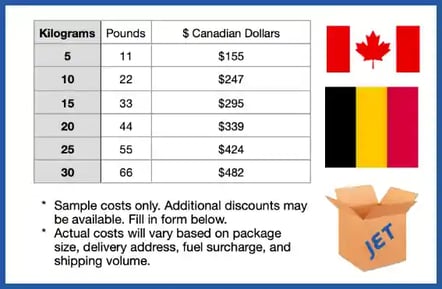
Shipping to Belgium from Canada via Jet Worldwide
Jet Worldwide has provided international delivery from Canada for over 40 years. We can help you select the appropriate carrier and service level, align documentation to customs requirements, and design solutions for complex moves—including temperature-controlled and dry ice shipments.
Temperature-Controlled Shipping and Dry Ice Shipments (Canada to Belgium)
If your shipment requires frozen or deep-frozen transport, dry ice is a common approach—particularly for air movement—provided the packaging, labeling, and documentation meet carrier and air-transport rules.
Typical commodities shipped on dry ice
- Laboratory reagents, diagnostic samples, and test materials requiring frozen transport
- Clinical trial shipments requiring controlled temperature profiles and predictable transit
- Biotech materials such as enzymes, proteins, and other temperature-sensitive inputs
- Frozen specialty foods where maintaining frozen state is essential to quality
Note: Requirements vary by carrier, service, and shipment configuration. Confirm Jet's acceptance rules for your commodity before tendering a dry ice shipment for shipping from Canada.
Customs Clearance for Imports to Belgium from Canada
Customs clearance commonly requires importer identification and tax registration in Belgium/EU (often involving VAT registration and/or representation within the country). Missing invoice details are a frequent cause of delay—especially for regulated or technical goods.
Common missing details on commercial invoices
- Audio/video media: include dimensions/format details where required, a brief description of content, and reason for export.
- Software on physical media: clearly separate software value from support/services value, when applicable.

For guidance on valuation practices, see: Declared value for international courier shipments .
VAT assessment for parcels imported into Belgium
While some low-value shipments may be eligible for duty relief depending on the commodity and threshold rules, VAT is commonly assessed. For background on VAT collection models used for EU e-commerce (including IOSS concepts), see: VAT for online orders shipped to Europe.
Shipping Canadian D2C / E-commerce Orders to Belgium (EU)
Jet Worldwide supports cross-border e-commerce shipping for Canadian retailers, including solutions that prioritize predictable delivery, compliant documentation, and scalable EU distribution. For temperature-sensitive products, we can help evaluate whether a controlled ambient, chilled, or frozen approach is needed—and whether dry ice is appropriate for your lane and service model.
Low-Value Import Rules and Fees: 2026 Outlook
A €3 duty for parcel imports applies to each distinct item category (based on tariff sub-headings) contained within the parcel. An additional €2 handling fee will apply in November.
For official background on VAT and EU import models, consult the Publications Office of the European Union: EU VAT rules and IOSS reference publication .
Duty-Free Import to Belgium from Canada Under CETA
Canada and the European Union benefit from CETA, which may enable preferential duty treatment for qualifying goods. Eligibility depends on whether the product meets the applicable rules of origin and whether the shipment is supported by proper origin statements or documentation.
CETA rules of origin: what matters
To qualify as “originating” under CETA, a product must meet origin criteria (for example, sufficient production or transformation in Canada or the EU). Simply purchasing a product in Canada and shipping it to Belgium does not automatically make it “Canadian origin.”

Learn more about origin rules here: Understanding country of origin rules for preferential duty treatment.
Two common origin methodologies referenced in trade rules include: (1) change in tariff classification, and (2) regional value content. Sector-specific rules may apply (e.g., textiles, automotive, chemicals). Always confirm requirements with the importer/consignee and applicable authorities before shipping.
- Change in tariff classification: the product must undergo a sufficient tariff shift due to production/transformation.
- Regional value content: a required percentage of value must be added within Canada/EU, depending on the rule.
Certificates and declarations of origin
Country of origin information supports preferential duty assessments and may also support regulatory actions (e.g., quotas, quarantine, or product compliance measures). In many cases, CETA does not require a standalone certificate; an origin declaration on a commercial document may be sufficient—provided it follows the required format. Always verify current wording requirements prior to shipping.
Read more: Understanding a certificate of origin.
Import Clearance of Parcels into Belgium: Key Data Fields
Most carriers submit customs information electronically (EDI). Missing identifiers are common causes of delay. Ensure the following fields are complete and accurate:
- Consignee VAT / importer number (a frequent cause of customs delays when missing)
- EORI number (Economic Operators Registration and Identification)
- AEO number (if applicable)
- Terms of sale / Incoterms and who pays duty/VAT (DDU vs. DDP)
Unless explicitly stated on the invoice and shipment data, carriers often assume duties/taxes will be paid by the consignee (Delivery Duty Unpaid). If you intend to ship Delivery Duty Paid (DDP), align the service selection and paperwork accordingly.
HS Codes and the EU Classification System (Belgium)
Finding the tariff classification for Belgium imports
Belgium (as an EU Member State) applies the European Commission’s Combined Nomenclature (CN), which helps determine customs duty treatment and statistical reporting. The EU classification structure is often described in three integrated layers:
- Harmonized System (HS): chapters (2 digits), headings (4 digits), and subheadings (6 digits). Read about HS Codes.
- Combined Nomenclature (CN): EU-specific detail commonly expressed as an 8-digit code.
- TARIC (Integrated Tariff): tariff measures and additional controls (e.g., suspensions, anti-dumping, specific measures).
Shipping Personal Effects to Belgium from Canada
Personal effects may be eligible for duty/tax relief under specific conditions. Requirements vary by case and are subject to customs review. Ensure your documentation is explicit and complete.
Common personal effects requirements
- A detailed commercial invoice listing each item clearly
- Include a statement such as: “PERSONAL EFFECTS. USED ITEMS NOT FOR RESALE”
Practical notes
- Restricted items are not permitted.
- Articles less than one year old and new items (such as gifts, souvenirs, and new clothing) may not qualify as personal effects and may be subject to duty/VAT.
- Personal effects are often subject to inspection by Belgian customs.
Common approaches
- Excess baggage: for a small number of bags, this can be simpler than shipping separately.
- Boxes: economy air options can be practical for a few cartons.
- Household moves: for container-level shipments, use a moving specialist for packing and ocean transport planning.
Shipping Product Samples to Belgium from Canada
Some samples may qualify for duty/VAT relief depending on how they are prepared and declared. Confirm expectations with the consignee before shipping.
Requirements often associated with sample treatment
- Only a single item of each sample may be accepted (note: a “pair” can count as multiple items).
- Mutilated samples: rendered unsuitable for sale (e.g., a prominent hole, removal of a sleeve, one shoe altered).
- Marked samples: clearly marked “SAMPLE” with indelible contrasting ink, visible upon inspection.
- Invoice wording: clearly indicate sample status (examples below).
- Mutilated Samples, Not for Resale
- Marked Sample, Not for Resale
Temporary imports for demonstration may require special entry processes, deposits, and export timelines (often within one year). Do not assume sample status—confirm the exact customs approach for your scenario.
Sending Goods for Trade Shows in Belgium
As an EU hub, Belgium is a frequent destination for trade shows. Many events have a designated customs broker to facilitate efficient clearance for booths, displays, and promotional materials. We recommend confirming instructions with the trade show organizer and forwarding those requirements to your logistics provider in advance. Jet Worldwide can coordinate with local affiliates in Belgium to support trade show logistics end-to-end.
Sending Parcels to Belgium Containing Gifts
“Unsolicited gifts” sent to individuals may qualify for relief under certain value thresholds and conditions. Customs authorities can be strict, and eligibility depends on correct packaging, labeling, and documentation.
Common best practices for gift shipments
- Clearly describe each item and its value on the invoice.
- Use wording indicating the shipment is an unsolicited gift and not for resale.
- Do not include restricted items.
For individuals shipping small gifts, postal services can be a practical option. Gifts sent to companies typically do not qualify for gift exemptions; for business recipients, consider a Delivery Duty Paid (DDP) model to improve delivery experience.
General Standards and Compliance Notes (Canada to Belgium)
Before shipping, confirm any applicable product standards with the importer. As an EU Member State, Belgium enforces EU directives and regulatory requirements that may apply to your products, including (as applicable):
- EU safety directives
- CE markings
- Electrotechnical standardization requirements
- Battery and accumulator regulations (including restricted substances)
- Eco-label and environmental compliance requirements (where applicable)
- Telecommunications standards (where applicable)
For non-originating goods that do not meet CETA rules of origin, MFN tariff rates can apply. For qualifying goods, CETA may enable preferential duty treatment supported by proper origin declarations.
Duty-Free Shipping from Belgium to Canada: Low-Value Threshold Considerations
Canada’s CBSA has harmonized a low-value threshold for waiving formal proof of origin for many free trade agreements (including CETA) at CAD $3,300 (verify current policy prior to shipping). For commercial importations at or below the threshold, customs may accept a certifying statement on the commercial invoice referencing preferential treatment under CETA.
Sample certifying statement wording (illustrative only):
“I hereby certify that the goods covered by this shipment qualify as an originating good for the purposes of preferential treatment under Canada-European Union CETA.”
Important: Claims above the low-value threshold typically require the applicable proof of origin and supporting documentation. Refer to CBSA guidance to confirm current requirements: CBSA ‘Origin of goods’.