Posts from Jet Team

A Major Shift for E-commerce imports to the U.S.

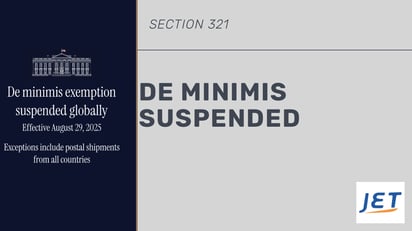
Effective August 29, 2025, a significant change is coming to how international mail shipments are processed upon entry to the United States1. Pursuant to Executive Order 14324, issued on July 30, 2025, the duty-free de minimis treatment for all countries is being suspended for shipments entering the U.S. through the international postal network. This means that carriers and other approved "qualified parties" must now collect and remit duties for articles that were previously eligible for this exemption.


Read More

The End of an Era: Section 321 and Entry Type 86 Discontinuation

A huge policy shift, including both executive orders and legislative actions, mark the effective termination of the broad de minimis /Section 321 /Entry Type 86 exemption. This shift mandates a transition to more rigorous import procedures, primarily informal Entry Type 11 and formal Entry Type 01 entries. The implications for global e-commerce are far-reaching.

Re-evaluation of supply chain and fulfillment models are imperative to navigate this new regulatory environment successfully. High volume e-commerce importing is still possible via new processes.


Read More

Tariffs for USA Imports Effective August 2025

An executive order detailing new reciprocal tariff rates for imports from virtually all countries will take effect August 7, 2025. Goods loaded onto a vessel and in transit on their final mode of transit before August 7 will avoid the new tariffs. Also, goods withdrawn from a bonded warehouse for consumption) before October 5, they will not be subject to the new tariffs.


Read More


The End of an Era: Section 321 De Minimis Set to Close Forever on August 29th

Section 321 "de minimis" exemption - a cornerstone of e-commerce imports , has been eliminated. The time to build new processes is now.


Read More

Low value e-commerce containing cosmetics, creams, lotions, supplements, food, and other  U.S. Food and Drug Administration (FDA) regulated goods are now subject to full approval. All prior exemptions of certain low-value FDA-regulated products I've been rescinded All FDA-regulated goods are now subject to stringent approval and clearance processes, and critically, they cannot be cleared via the low-value Section 321 entry.


Read More

DHL has reached a tentative agreement with the union.

 DHL Express Canada suspension of its operations nationwide has had ripple effects throughout major supply networks. Businesses have scrambled to find short and long term alternatives.  


Read More

In today's interconnected world, seamless international and domestic shipping is no longer a luxury, but a necessity. For businesses and individuals alike, navigating the complexities of global logistics can be a daunting task. This is where Jet Worldwide steps in, transforming the often-stressful world of shipping into a smooth, efficient, and stress-free experience.


Read More

First Sale Rule: 2026 Executive Summary

In a global market defined by high duty rates, importers are under intense pressure to reduce costs. The First Sale valuation method is a powerful—but heavily audited—strategy to lower duty paid by declaring a manufacturer’s price rather than a middleman’s markup.

  • Standard Method: Transaction Value (Simple and Audit-Proof)
  • Strategic Method: First Sale (Complex but High-Reward)
  • Innovation: Use AI to audit multi-tier supply chain documentation for compliance.

Read More

International shipping opens up a world of opportunities, allowing businesses to reach new markets and customers. However, one of the most critical — and often daunting — hurdles is customs clearance. This process can seem like a complex maze of paperwork, regulations, and potential delays. But fear not! With the right knowledge and a reliable partner, you can navigate customs with confidence.


🤖 AI-Powered Quick Summary

  • Core Goal: Ensure goods comply with local laws to avoid fines and seizures.
  • Key Tool: Use HS Codes for standardized global classification.
  • Documentation: The Commercial Invoice is your most vital document.
  • Expert Tip: Always declare the "Transaction Value" to avoid legal penalties.

At Jet Worldwide, we understand the complexities of cross-border trade. This step-by-step guide will demystify the customs clearance process, helping you ensure your international shipments move smoothly and efficiently.

Why Customs Clearance Matters (And Why You Can't Afford to Get It Wrong)

Customs clearance isn't just a bureaucratic formality; it's a crucial step that ensures goods entering or exiting a country comply with local laws and regulations. Getting it wrong can lead to:

  • Significant Delays: Your shipment stuck at the border, costing you time and customer satisfaction.
  • Unexpected Costs: Fines, storage fees, or unforeseen duties and taxes.
  • Seizure of Goods: In severe cases of non-compliance, your shipment could be confiscated.
  • Damage to Reputation: Unreliable delivery can harm your business's standing.

Your Step-by-Step Guide to Smooth Customs Clearance

Step 1: Understand Your Product (HS Codes and Valuation)

Before anything leaves your warehouse, you need to become familiar with the harmonized code system. Rather than relying on a vague product description, customs uses a global system called the Harmonized System (HS). While each country has its own specific variations, the fundamentals are globally recognized.

The system can be compared to an encyclopedia with chapters, headings, and subheadings. There are specific General Rules of Interpretation (GRI) on how to translate your product description into a 10-digit code.

Declaring a Value for Export and Import

You must declare the true value of your goods. This value, along with the HS code, is used to calculate duties and taxes. Under-declaration is illegal and can lead to severe penalties. In most cases, the correct value to declare is the "transaction value"—the price actually paid or payable for the goods. For example, if you sold the goods for $3,000, that is the value to declare.

Read More

Shipping Goods direct to Canada versus via the USA

For years, the well-trodden path for many foreign companies looking to tap into the Canadian market involved a simple equation: conquer the behemoth that is the United States, and let your US operations handle the comparatively smaller Canadian market. It made sense. The US, with its massive consumer base and established infrastructure, often served as the natural entry point and distribution hub for North America. Think of it like how the United Kingdom, prior to Brexit, often acted as a primary distribution point for US companies targeting the European Union. With established logistics and cultural familiarity, it was logical to import goods into your largest regional market and then leverage that base to reach neighboring countries.


Read More