Express carrier shipments (imports via FedEx, UPS, and DHL) under USD 2,500 rarely make the headlines. However, during the eleven months of IEEPA tariffs, they carried a meaningful share of the duty bill — mostly paid by individuals and small businesses.
Key Takeaways
- IEEPA tariffs were collected from March 2025 through 24 February 2026. Roughly USD 166 to 175 billion was collected across all entry types.
- Informal entries under 19 CFR Part 128 covered most FedEx, UPS, and DHL imports valued at USD 2,500 or less.
- The importer of record on an express informal entry is the ultimate consignee, not the carrier.
- Informal entries liquidate at clearance, which complicates the refund path for previously paid IEEPA duty.
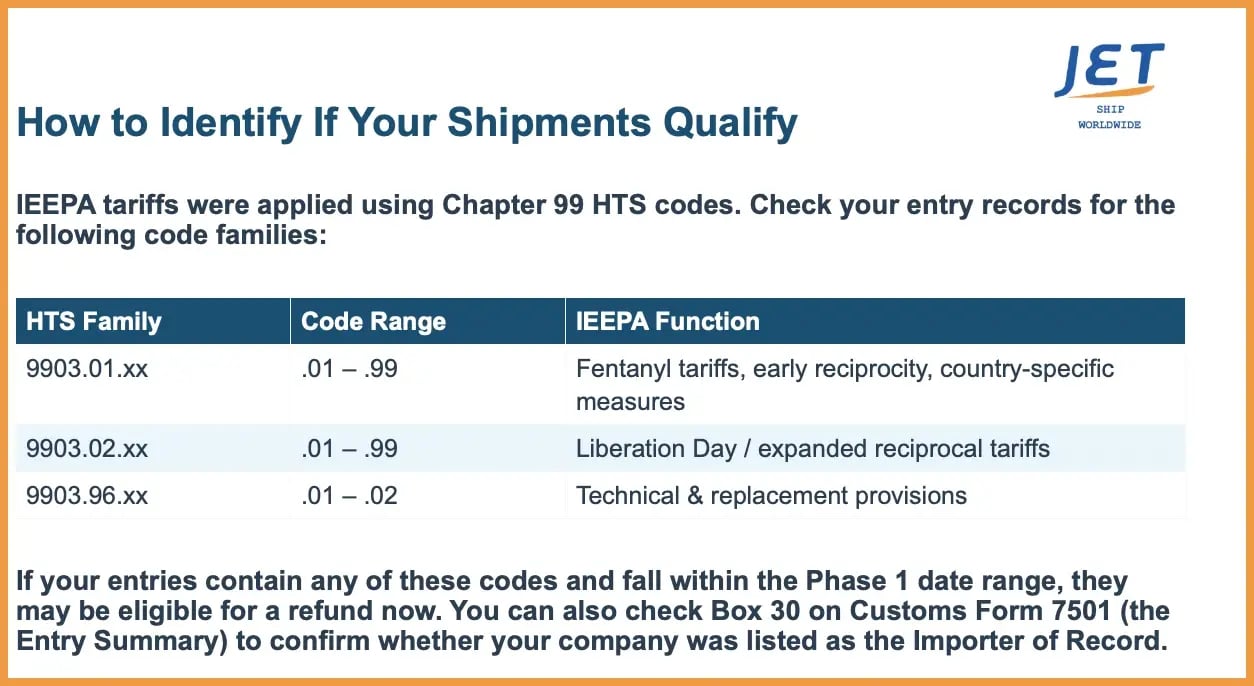
- Phase 1 of CBP's CAPE refund system does not currently address informal entry refunds.
IEEPA in Force
~11 Months
Mar 2025 to Feb 2026
Total Collected
USD 166 to 175B
All entry types
Informal Entry Cap
USD 2,500
19 CFR 128.24(a)
Refund System
CAPE Phase 1
Live since 20 Apr 2026
What Part 128 Actually Covers
19 CFR Part 128 is the CBP framework governing express consignment operators and carriers. It covers the hub operations run by FedEx, UPS, DHL, plus a few independent facilities (IBC, Micom). Under 128.24(a), informal entry procedures are generally used for non-restricted shipments not exceeding USD 2,500 in value. These shipments are most often consolidated on a single entry. The entry is filed on CBP Form 3461 or its electronic equivalent, with the advance manifest serving as a supporting document.
This was the "de minimis" workhorse for individual parcels shipping into the United States. Before the de minimis suspension took hold in August 2025, a large share of these parcels cleared duty-free under Section 321. Once de minimis was suspended for all countries, an informal entry was used for most imports under USD 2,500.
NOTE: We will continue to update this post as information on the next phase of IEEPA refunds becomes available for duty paid via FedEx, UPS, and DHL.
READ ABOUT IEEPA REFUNDS VIA CAPE →
The headlines have mostly involved large importers such as Toyota, Costco, Elizabeth Arden, and Reebok who proactively filed suit in the Court of International Trade. But there are thousands of small businesses who have paid anywhere from a couple hundred dollars to tens of thousands of dollars in IEEPA tariffs. Many of these goods arrived via FedEx, UPS, and DHL.
The complicating part is that most of these imports qualified as informal entries. The carriers made entry on behalf of the consignee. And these entries are typically not individual entries but are consolidated with thousands of other shipments. In other words, there is not a single entry number attached to each waybill. Rather, there is one entry linked to thousands of individual shipments.
The other complicating part is that the refund itself is issued via the ACH payment system. Most companies who receive goods via FedEx, UPS, and DHL do not have an ACH refund account set up.
How IEEPA Applied on an Informal Entry
There was nothing special about IEEPA via an informal entry. The same rules applied. The Chapter 99 headings — 9903.01.25 for China, 9903.01.10 for Canada, 9903.01.01 for Mexico, and the reciprocal tariff headings for other origins — were reported on the entry like any other ad valorem duty. The rates stacked on top of the standard MFN (column 1) rate plus other section tariffs such as Section 301 and Section 232.
What makes express informal entries distinctive is that carriers can make an entry on behalf of the consignee without securing authorization to do so. For formal entries, by contrast, a power of attorney is required.
Informal Entries and IEEPA Refunds: Three Issues to Know
1. Nominal Consignee versus Importer of Record
The nominal consignee designation exists in Part 128 for scenarios where the US-based party shown on paperwork is the carrier, forwarder, or consolidator itself, not the ultimate buyer. In that case, a carrier's IRS EIN can appear on the entry, but this is for manifest identification, not IOR status.
2. Informal Entries Liquidate Immediately
Under 19 CFR 159.10(a), the effective date of liquidation for an informal entry is the date of duty payment or the date of release. Nearly every informal entry that paid IEEPA duty was already finally liquidated by the time the Supreme Court ruled. A Court of International Trade (CIT) amendment issued 27 March 2026 extended refund relief to finally-liquidated entries. This extension may be challenged on appeal.
3. Delivery Duty Paid (DDP) Shipments
Under DDP terms, the commercial arrangement often has the shipper outside the USA paying the IEEPA duty along with other import charges. This does not change who CBP records as the IOR on the entry. The duty-payer and the IOR are legally distinct. For the purposes of CBP, the consignee remains liable for compliance even on DDP shipments. DDP terms apply to formal entries as well but are much more common on lower-value imports for product samples and warranty parts.
Representative Duty Math on Typical Informal Entries
| Origin and Tariff Type | Declared Value | IEEPA Rate | Duty Paid |
|---|---|---|---|
| China (fentanyl plus reciprocal) | USD 500 | 30% | USD 150.00 |
| Canada (non-USMCA) | USD 1,200 | 25% | USD 300.00 |
| EU (reciprocal) | USD 900 | 15% | USD 135.00 |
| Vietnam (reciprocal) | USD 2,200 | 20% | USD 440.00 |
Rates shown are representative of peak periods during the IEEPA window. Actual rates varied over time as executive orders were amended and country-specific pauses took effect.
Estimating the Informal Entry Share
CBP does not publish a clean breakdown of IEEPA duties by entry type, so actual figures are not known.
- Informal entries account for a minority of duty dollars but a large share of entry count. The bulk of IEEPA collections sat on formal entries clearing full commercial shipments.
- After August 2025, when de minimis was suspended, express informal entries absorbed hundreds of millions of parcels per month that had previously cleared on a manifest.
- Assuming informal entries represent roughly 3 to 5 percent of IEEPA duty dollars, the range lands at approximately USD 5 billion over the eleven-month window.
Average Declared Value
The estimated average value of Section 321 de minimis entries was only around USD 40. However, many of these were imported with under-declared values and, in any case, lost their duty-free status when de minimis was suspended. Courier-classified B2C shipments and B2B replenishment parcels for commercial consignees likely resulted in a higher average declared value, but the exact number is not known.
Who Was the Importer of Record
This is the part that trips up a lot of importers, and it matters enormously for the refund process. On an express informal entry, the importer of record is the ultimate consignee — the business or person in the United States to whom the goods are consigned. The express carrier is not the IOR even if their identification number is used as a header on the consolidated entry.
19 CFR 143.26 governs who may make entry on an informal shipment:
The parties eligible to enter are the owner, the purchaser, or the consignee of the goods. On an express informal entry, the carrier is almost never the owner or purchaser, so by default the ultimate consignee fills the IOR role.
What makes express carriers look like the IOR is a separate mechanic: the carrier is the entry filer acting as a customs broker. FedEx, UPS, and DHL each hold customs broker licenses and file the CBP Form 3461 on behalf of the consignee using their own filer code. In ACE, the entry shows the carrier's broker as the filer, but the IOR field carries the consignee's name, US address, and IRS employer ID number, SSN, or CBP-assigned number.
How the IEEPA Line Appears on Carrier Invoices
IEEPA duties on express informal entries were billed to the consignee on the carrier's duty and tax invoice, typically ten to twenty business days after delivery. The IEEPA portion is identifiable on carrier duty invoices by the Chapter 99 HTS reference (9903.xx.xx) alongside the MFN classification. In some cases, mostly with respect to imports via UPS, the details of the entry are not always provided.
What the Supreme Court Ruling Changed
On 20 February 2026, the Supreme Court held IEEPA tariffs to be invalid. Duties were no longer charged beyond 24 February 2026. A Section 122 surcharge was imposed almost immediately under separate authority, so shipments entering the US today still incur additional duty beyond the standard MFN rate. The IEEPA line is gone, and tariffs paid under this authority are now starting to be refunded for formal entries to importers with an ACH refund account on file.
Refunds on Informal Entries: What to Expect
Phase 1 of CBP's Consolidated Administration and Processing of Entries (CAPE) system is active. CBP pushes refunds via ACH to the importer's bank details on file. However, Phase 1 does not currently address refunds on informal entries. Phase 2 is expected to extend the process.
Most consignees on express informal entries, particularly small businesses and individual consumers, never registered an ACH account with CBP because they never expected to be treated as an importer of record. The express carrier handled everything. Consignees will need to sign up for electronic refunds, as CBP no longer issues paper checks.
A further complication: when the shipper paid the duty under DDP terms through the carrier's account, the commercial reality is that the shipper absorbed the cost, not the consignee. But the refund goes to the IOR, which is the consignee. How shippers recover duty they effectively paid on behalf of their customers is a commercial question between the parties, not a CBP question.
What the ACH System Is
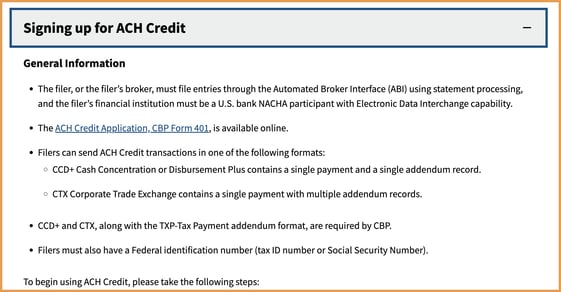
How to Enrol in ACH Refunds with CBP
- Confirm your CBP Form 5106 record. This is the importer identity record CBP needs before any portal access works.
- Create an ACE Portal account. Apply for an account tied to your 5106 record, with the Importer sub-account view enabled.
- Authorize ACH refund in ACE. Provide a US bank account routing and account number along with your TIN, SSN, or CBP-assigned number.
- Verify by email. CBP sends a verification code to the email address on file in your 5106 record. Coordinate with whoever owns that inbox.
What Happens Now for Informal Entries
There is an expectation that IEEPA refunds will eventually be applied for informal entries through Phase 2 of CAPE. For businesses using express informal entries, the action now is to record what was paid, confirm your importer identity record, and prepare the bank details of a US-based account that can be linked to ACH.
Practical Next Steps
- Pull carrier duty invoices from March 2025 through February 2026, isolate the Chapter 99 IEEPA lines, and keep that reconciliation in a format you can produce on demand.
- Confirm your business is registered with CBP as an importer (CBP Form 5106) and that ACH refund details are on file.
- If you imported under DDP terms and your shipper absorbed the duty, document the commercial arrangement now in case a refund reconciliation is needed.
- Monitor CSMS messages and your carrier's communications for CAPE Phase 2 filing instructions.
Frequently Asked Questions
Who is the importer of record on an express carrier informal entry?
On an express informal entry under 19 CFR Part 128, the importer of record is the ultimate consignee. This is governed by 19 CFR 143.26. The express carrier is the filer of record, acting as a licensed customs broker, but is not the IOR.
Do informal entries liquidate immediately?
Yes. Under 19 CFR 159.10(a), the effective date of liquidation for an informal entry is the date of duty payment or the date of release. Unlike formal entries, which liquidate on a roughly one-year cycle, informal entries liquidate at clearance.
How will IEEPA refunds be distributed on informal entries?
CBP issues refunds via ACH to the importer of record on file. Phase 1 of CAPE launched 20 April 2026 but does not currently address informal entry refunds. Phase 2 is expected to extend the process. We expect consignees will have to enrol in ACH refunds through the ACE Portal.
How do I identify IEEPA duty on a FedEx, UPS, or DHL invoice?
IEEPA duty appears on carrier invoices as a Chapter 99 HTS reference in the format 9903.xx.xx, alongside the article's primary MFN classification.
Who receives the refund on a DDP shipment?
CBP refunds the importer of record, which is the consignee, not the shipper. If the shipper paid duty under DDP terms, recovering that amount from the consignee is a commercial matter between the parties.