Canada represents one of the most accessible and profitable export markets for American businesses. With shared language, cultural familiarity, and strong purchasing power, expanding north of the border is a natural next step. But cross-border selling is not the same as domestic shipping. You need a Canadian Business Number, CARM registration, the right customs broker, and a smart logistics strategy. This guide walks you through every step from registration to final delivery.
Why Canada Is the Best First Export Market for US Sellers
For American businesses looking to go international, Canada checks every box. Geographic proximity means faster transit times and lower freight costs. Cultural and business similarities reduce the learning curve. And with one of the highest per-capita incomes globally, Canadian consumers have strong purchasing power and a built-in familiarity with American brands.
View our video: How to Import to Canada from the USA
Here is what makes Canada especially attractive:
- Geographic advantage: Shared border, aligned time zones, and established cross-border transportation networks make logistics straightforward.
- Affluent consumer base: Canada consistently ranks among the top nations for household spending and disposable income.
- Brand recognition: Canadian buyers already know and trust many American brands, reducing the cost of market entry.
- Free trade access: The Canada-United States-Mexico Agreement (CUSMA) eliminates or reduces duties on qualifying goods shipped between the three countries.
- Major demand centers: Population clusters in Ontario, Quebec, British Columbia, and Alberta offer concentrated market opportunities.
- Gateway to global markets: Canadian ports like Vancouver and Montreal provide onward access to Europe and Asia-Pacific trade routes.
The opportunity is clear. The question becomes: how do you set up the compliance framework and logistics to sell to Canada efficiently?
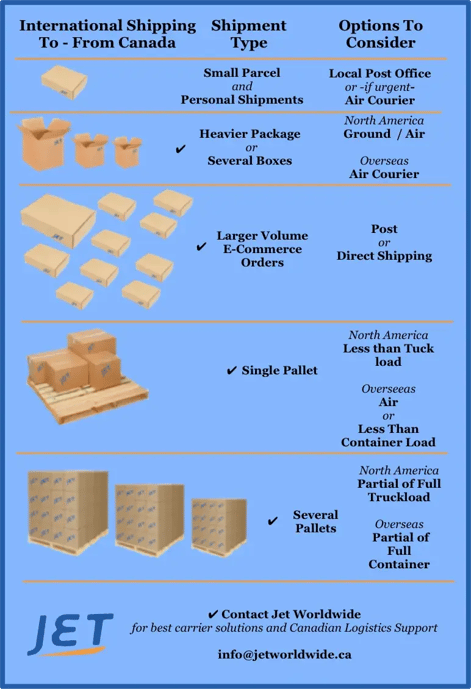
Please feel free to send us your USA Canadian shipment details for a shipping quote:
-
ZIP Code of pick up location in USA
-
Postal code of delivery location in Canada
-
Commodity and tariff classification (if known)
-
Weight and dimensions
-
Cargo ready date
-
Preferred mode of transport (Air / Road)
Step 1: Get a Canadian Business Number (BN9)
(Or make sure your customer has one)
Before shipping to Canada, confirm that your customer is registered. Importers need a nine-digit Business Number (BN9) issued by the Canada Revenue Agency (CRA). This number is the foundation of a Canadian trade identity. It links a import-export program account (known as an RM account) and is required for customs clearance, tax remittance, and CARM registration.
How to Obtain Your BN9
For non-resident businesses (US companies): You must request your BN9 directly from the CRA before attempting to register in the CARM Client Portal. Attempting to register without a pre-issued BN9 will trigger a registration error that requires contacting the CARM Client Support Helpdesk to resolve.
For resident businesses: Most new Canadian-resident businesses can obtain their BN9 during the CARM portal registration process itself.
Once you have your BN9, you will also need an RM (import-export program) account number. If you do not already have one, you can enrol during your CARM Client Portal registration.
Get Started: Register for a Business Number →
Step 2: Become a Non-Resident Importer (NRI)
One of the most important strategic decisions for US sellers shipping to Canada is determining who acts as the Importer of Record. Under the Non-Resident Importer (NRI) model, the US seller takes full responsibility for the Canadian importation process rather than leaving it to the Canadian buyer.
Why the NRI Model Matters
Even when goods qualify for duty-free treatment under CUSMA, most commercial shipments entering Canada are still subject to the five percent Goods and Services Tax (GST) at the time of import. The NRI model lets you control how that process is handled.
Four Key Advantages of the NRI Approach
- Simplified buying experience: Your Canadian customer does not need to register in CARM, post financial security, set up customs brokerage, pay border taxes, or manage customs audits. You remove friction from the purchase.
- Predictable landed pricing: You can offer a delivered price that includes freight, brokerage, and taxes. No surprises for the buyer.
- Compliance control: You manage product classification, CUSMA origin certification, customs valuation, and documentation accuracy. This reduces risk of errors and penalties.
- Stronger market presence: Acting as the importer lets you sell to Canadians as though you were a Canadian company, building lasting customer relationships.
NRI Registration Requirements
To act as a Non-Resident Importer, you need to:
- Obtain a Canadian Business Number (BN9) with an RM import-export account
- Register in the CARM system
- Post financial security (surety bond or deposit) with Canadian customs
- Appoint a licensed Canadian customs broker
- Pay applicable duty (if not CUSMA-eligible) and GST, which is often recoverable through input tax credits
Full NRI Guide: Structure Your Sales to Canada →
Step 3: Find a Canadian Customs Broker
A licensed Canadian customs broker is a private company authorized by the Canada Border Services Agency (CBSA) to transact imports on your behalf. They are not a government body. Brokers handle entry preparation, data transmission, duty and tax disbursement, and post-entry compliance work.
Do You Need a Broker?
Technically, importers can self-clear goods into Canada. However, for most commercial operations, working with a broker saves time, reduces compliance risk, and ensures smoother clearance. You have three main options:
Do You Need a Broker if I ship with FedEx or UPS to Canada
FedEx and UPS have brokerage options for both express and ground shipments. Shipments over $3,300 require a Power of Attorney from the importer to authorize clearance on their behalf.
For ground shipments, entry preparation cost is not included. See UPS and FedEx Ground Entry Preparation Fees.

| Option | Best For | Considerations |
|---|---|---|
| Self-Clear (DIY) | Low volume, low complexity | Lowest fees but time-consuming with higher compliance risk |
| Carrier Brokerage (UPS, FedEx, DHL) | Courier parcels, small e-commerce | Fast for express shipments but limited advisory depth |
| Independent Broker | Growing or complex import programs | Deeper compliance support, scalable SLAs, post-entry expertise |
Common Import and Brokerage Fees to Understand
Before signing with a broker, make sure you understand the typical fee structure: entry fees per shipment, disbursement or advancement fees when the broker pre-pays duty and tax, EDI or eManifest transmission charges, per-line-item surcharges beyond a base number of HS lines, post-entry correction fees, and bond or security administration costs.
Understanding common Canadian Import Fees
Pro Tip: Ask your broker for an all-in landed cost template that shows broker fees, carrier disbursements, and typical CBSA amounts so your finance team can budget accurately.
Choosing a Canadian Customs Broker: Full Guide →
Step 4: Register in CARM (CBSA Assessment and Revenue Management)
CARM is the official system of record that the Canada Border Services Agency uses for collecting duties and taxes on commercial imports. Every business that imports goods into Canada, including Non-Resident Importers, must register in the CARM Client Portal. This is not optional. Without CARM registration, your goods cannot clear the border through the standard Release Prior to Payment (RPP) program.
CARM Registration: Step by Step
- Obtain your BN9 first: Non-resident businesses must have their CRA-issued Business Number before attempting portal registration. Trying to register without it triggers errors that require helpdesk intervention.
- Create a CARM Client Portal (CCP) business account: Visit the CARM Client Portal and create your account using GCKey or a Sign-on Partner credential.
- Designate a Business Account Manager (BAM): Your BAM receives global access and manages user permissions for your organization within the portal.
- Delegate authority to your customs broker: Navigate to "Setup My Portal," then "Manage My Business Relationships," then the "Received Requests" tab to approve your broker's Delegation of Authority request.
- Post financial security: Obtain a surety bond or make a security deposit to enroll in the Release Prior to Payment program. Without an RPP bond, you must pay duties and taxes upfront at the port of entry before goods are released.
Key Information Your Broker Needs
Once registered, confirm the following details with your customs broker to avoid clearance delays:
- CARM contact name and email address
- Full legal entity name of your company
- CRA Business Number (BN9) including your RM account number
- Confirmation that your CCP business account is created
- Confirmation that Delegation of Authority has been granted
Complete CARM Registration Guide →
Step 5: Leverage CUSMA for Duty-Free Shipping
The Canada-United States-Mexico Agreement (also known as USMCA in the United States and T-MEC in Mexico) is the successor to NAFTA. For US sellers shipping to Canada, CUSMA offers significant duty reduction or elimination on qualifying goods, making cross-border trade substantially more cost-effective.
Key CUSMA Benefits for E-Commerce Sellers Shipping to Canada
- Duty-free and tax-free threshold: Goods valued under CA$40 enter Canada free of both duty and sales tax.
- Duty-free threshold: Goods valued under CA$150 enter Canada duty-free, though provincial sales tax still applies.
- Low Value Shipment (LVS) processing: Parcels valued up to CA$3,300 qualify for simplified LVS customs procedures.
- Simplified certification of origin: The certification process no longer requires a prescribed form. Origin data elements can be included directly on the commercial invoice.
How to Claim CUSMA Preferential Treatment
To qualify for duty-free treatment under CUSMA, you must:
- Determine your HS code: Identify the correct Harmonized System classification for your product.
- Verify rules of origin: Confirm your goods meet the product-specific rules of origin written into the agreement based on HS codes.
- Complete a certification of origin: Include the required data elements on your commercial invoice or a separate document. A CUSMA certification must include: the certifier identity (importer, exporter, or producer), names and addresses of the relevant parties, product description with HS tariff classification, the specific origin criteria met, blanket period if applicable (up to 12 months for identical goods), and an authorized signature with date.
- Provide the certification with the shipment: Your customs broker and the importer of record need this documentation to claim preferential tariff treatment at the border.
Important Note on USPS and Canada Post
If goods are shipped via USPS and delivered through Canada Post, different thresholds apply. The duty-free and tax-free threshold for postal shipments is only CA$20 (approximately US$14.75). Above that amount, duties and taxes are assessed. Parcels shipped via commercial carriers such as UPS, FedEx, DHL, or Jet Worldwide benefit from the higher CA$40 and CA$150 thresholds.
CUSMA Duty-Free Shipping: Full Breakdown →
Step 6: Consolidate, Store, and Ship from Canada with Jet Worldwide
Once your compliance framework is in place (BN9, NRI status, CARM registration, customs broker appointed), the next step is optimizing your physical logistics. Shipping individual parcels across the border for each Canadian order is expensive and inefficient. A smarter model involves consolidating inventory, clearing it through customs in bulk, and distributing domestically within Canada.

How the Bulk Consolidation Model Works
- Establish NRI status and CARM registration to act as the legal importer of record for your goods entering Canada.
- Consolidate inventory into bulk shipments: Instead of shipping individual orders across the border, batch your products into a single consolidated shipment. This dramatically reduces per-package brokerage fees and international line-haul costs.
- Clear customs as a single entry: Your bulk shipment clears the border under one customs transaction rather than dozens of individual entries, simplifying compliance and reducing fees.
- Store goods at a Jet Worldwide facility in Canada: Once cleared, your inventory is received and warehoused at a secure Canadian location.
- Distribute locally on demand: When a Canadian customer places an order on your website, Jet Worldwide picks, packs, and ships it as a domestic Canadian shipment. Your customers receive their items with domestic delivery speeds.
- Scale with low minimums: Jet Worldwide offers flexible pricing with low minimum charges, allowing you to maintain a Canadian inventory footprint without the overhead of traditional third-party logistics providers.
Why This Model Works
The bulk consolidation approach is especially effective for US sellers who want to reach Canadian buyers but do not yet have the sales volume for regular full-container shipments. By warehousing pre-cleared inventory in Canada, you eliminate border delays for individual orders, offer faster delivery times, and present a seamless domestic buying experience to your Canadian customers.
Get a Shipping Rate from Jet Worldwide →
Video: Shipping to Canada Explained
Watch this walkthrough for a visual overview of the key steps involved in setting up your cross-border shipping operation to Canada.
Frequently Asked Questions
Do I need a Canadian Business Number to ship commercial goods to Canada?
Not from the American shipper but yes for the Canadian importer. The Canada Revenue Agency requires a nine-digit Business Number (BN9) for any entity importing commercial goods into Canada. US-based companies who wish to import on behalf of their customers can become a non-resident importer by obtaining this number from the CRA before registering in the CARM system. You can begin the process at the CBSA CARM registration page.
What is a Non-Resident Importer and why should I consider becoming one?
A Non-Resident Importer (NRI) is a foreign company that registers to act as the Importer of Record in Canada. This means the US seller handles customs clearance, duty payment, and compliance rather than placing that burden on the Canadian buyer. The NRI model simplifies the customer experience, enables predictable landed pricing, and gives the seller direct control over border compliance. Learn more about the NRI model.
What is CARM and is it mandatory?
CARM (CBSA Assessment and Revenue Management) is the official digital system that the Canada Border Services Agency uses to collect duties and taxes on commercial imports. Registration is mandatory for all importers, including Non-Resident Importers. Without CARM registration and a surety bond, your goods cannot benefit from the Release Prior to Payment program and you will be required to pay duties and taxes upfront at the port of entry. Read the full CARM guide.
Can my US-made products ship to Canada duty-free under CUSMA?
Many US-manufactured goods qualify for duty-free entry to Canada under CUSMA (the Canada-United States-Mexico Agreement). To claim this benefit, your product must meet the agreement's rules of origin and you must provide a valid certification of origin. Even when goods are duty-free, the five percent GST still applies at import, though registered businesses can recover it through input tax credits. CUSMA details and thresholds.
Do I need a customs broker to import into Canada?
A customs broker is not legally required. Importers can self-clear goods or use a carrier's built-in brokerage service. However, for most commercial import programs, an independent licensed customs broker provides deeper compliance expertise, post-entry support, and scalable service levels that reduce risk and save time. Guide to choosing a customs broker.
What are the advantages of consolidating inventory in Canada instead of shipping individual orders across the border?
Bulk consolidation reduces per-package brokerage fees, lowers international shipping costs, and simplifies customs by clearing inventory as a single entry. Once goods are stored in a Canadian warehouse, orders ship domestically with faster delivery times and no border delays for the end customer. Jet Worldwide offers this consolidation and warehousing service with flexible low-minimum pricing suited for growing US sellers.

Quick Reference: Your 6-Step Roadmap
Step 1
Ensure a Canadian Business Number (BN9) from the CRA for importer
Step 2
Register as a Non-Resident Importer (NRI) - to lower entry cost and expand access.
Step 3
Appoint a licensed Canadian customs broker
Step 4
Register in CARM and post financial security
Step 5
Leverage CUSMA for duty-free preferential treatment
Step 6
Consolidate, warehouse, and ship from Canada with Jet Worldwide
Ready to Start Selling to Canada?
Jet Worldwide has been connecting businesses across borders for over 40 years. Talk to our team about NRI setup, customs brokerage, and Canadian warehousing.
Get a Free Consultation →