Quick answer: The newest US import duty is a 50 percent Section 338 tariff on select Canadian goods, effective August 19, 2026, and it applies even to USMCA-qualifying goods. IEEPA tariffs were struck down in February 2026 and Section 122 expired July 24, 2026. On the entry summary, report Chapter 98, then Chapter 99 duties, then Section 301, 338, 232 and 201, then the base classification.
What changed in 2026
US import duty policy moved through several distinct regimes in a single year. If you are working from documentation written before the summer of 2026, some of the duty layers it names are no longer collected, and at least one major new layer is not yet in it. Here is the sequence of events that matters for landed-cost and classification decisions today.
- February 20, 2026 — The Supreme Court struck down the IEEPA tariffs in Learning Resources, Inc. v. Trump. Reading the power to regulate imports as a taxing power was held to exceed the statute.
- February 24, 2026 — CBP stopped collecting IEEPA duties. A temporary 10 percent Section 122 surcharge took its place under HTSUS heading 9903.03.01.
- July 24, 2026 — The Section 122 surcharge reached its 150-day statutory ceiling and expired. Congress did not extend it.
- July 24, 2026 — At the same moment, new Section 301 forced-labor duties of 10 to 12.5 percent took effect across roughly 60 economies under CBP CSMS number 69326983.
- August 19, 2026 — Section 338 tariffs of 50 percent on select Canadian goods took effect, following three proclamations signed July 20, 2026.
De minimis context: the 800 dollar de minimis exemption has been suspended for all countries since August 29, 2025 and remains suspended. Under the One Big Beautiful Bill Act it is set to end permanently on July 1, 2027. Low-value shipments now require a formal or informal entry filed in ACE.
Section 338: the 50 percent Canadian tariff
Section 338 of the Tariff Act of 1930 is a long-dormant authority that allows the President to impose duties on the goods of a country found to discriminate against US commerce. For decades it was never used. In 2026 it became live: three proclamations signed July 20 imposed a 50 percent tariff on a defined list of Canadian goods, including automobiles, alcohol, dairy, furniture and other categories, effective August 19, 2026.
The detail that reshapes cost models for Canadian exporters is that this duty applies even to goods that qualify as originating under USMCA. A preference claim that would zero out the base rate does not remove the Section 338 layer. That is why your entry summary logic cannot treat a valid USMCA claim as the end of the duty question for these goods.
In Jet Worldwide data suggest a low percent of Canadian-origin entry lines require a corrected Chapter 99 sequence. Once the Section 338 heading is added we expect these volumes to decline further.
The other live layers: 301, 232, 201
Section 338 sits alongside trade-remedy programs that were not affected by the IEEPA ruling. Knowing which layers are live is the first step before any sequencing decision.
Section 301
The long-standing China lists remain in force. On July 24, 2026 a new forced-labor action added duties of 10 to 12.5 percent across roughly 60 economies. Section 301 has been a stable tariff authority for more than four decades, and the courts have repeatedly declined to disturb it.
Section 232
The steel, aluminum, automobile and copper measures remain in force, unaffected by the IEEPA decision. Since April 2026 the metals duties apply on the full value of the article rather than a metal-content subset, which materially raises landed cost on mixed-material goods.
Section 201
Safeguard measures on covered goods such as certain solar products remain available and, where applicable, report after the Section 232 layer in the trade-remedy sequence.
HTS sequencing: the correct order of reporting
When an entry summary line claims a heading or subheading in Chapter 98 or Chapter 99, CBP requires a fixed order for reporting the classifications on that line in ACE. Getting the order wrong can cause a rejected submission, an underpaid or overpaid duty, or a forfeited exclusion claim. The order below reflects the CBP framework as applied in 2026.
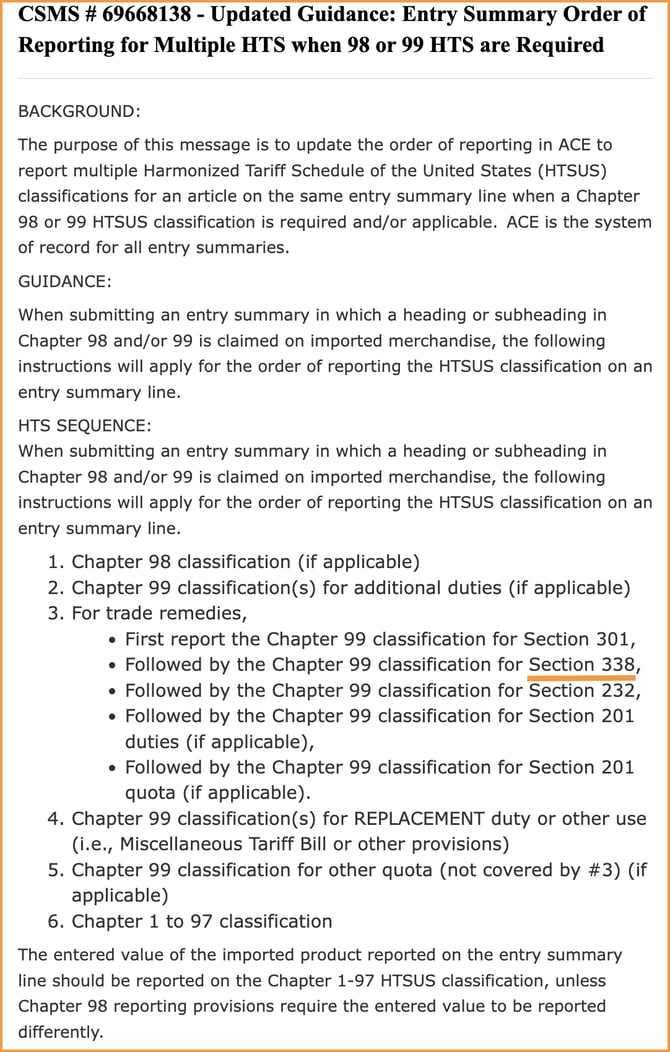
- Chapter 98 classification — if applicable.
- Chapter 99 additional duties — if applicable. This is the bucket that held the former IEEPA and Section 122 headings when they were live.
- Trade remedies, in order: Section 301, then Section 338, then Section 232, then Section 201 duties if applicable, then Section 201 quota if applicable.
- Chapter 99 replacement duty or other use — for example a Miscellaneous Tariff Bill provision or similar.
- Other quota — any quota not already covered above, if applicable.
- Chapter 1 to 97 classification — the base classification is reported last on the line.
Section 338 is now live.
How the layers stack: worked duty math
Duty stacking is a concept that defines how to apply a list of different duties that apply to a specific item. Does, for example, one tariff rule out the other? Or do the tariff ad - or stack - together?
Chapter 99 duty layers are additive ad valorem percentages applied to the customs value, reported before the base classification on the line. Antidumping and countervailing duties assess separately as a cash deposit and are not part of this ad valorem add-on. The worked examples below use illustrative base rates; the actual base rate is specific to your ten-digit HTS code and must be confirmed.
| Layer | China-origin steel article | Canadian furniture, USMCA-originating |
|---|---|---|
| Base classification rate (Chapter 1 to 97) | 2.9 percent | 0 percent under USMCA |
| Section 301 | 25 percent | not applicable |
| Section 338 | not applicable | 50 percent |
| Section 232 (metals, full value) | 50 percent | not applicable |
| Effective ad valorem duty | 77.9 percent | 50 percent |
In the first column, 2.9 plus 25 plus 50 equals 77.9 percent before the Merchandise Processing Fee and the Harbor Maintenance Fee. In the second column, a valid USMCA claim removes the base rate but does not remove the Section 338 layer, so the effective duty is 50 percent.
Stacking caution for Canadian goods: as of publication, CBP has not squarely addressed whether the new Section 301 forced-labor duty stacks on the 50 percent Section 338 tariff for goods that fall under both. If your Canadian goods could be exposed to both, confirm the treatment against current CBP CSMS guidance before quoting a landed cost.
Read more about new Type 13 Entry type for Postal Imports to the USA
See CSMS message from US customs
What importers should do now
- Re-screen every Canadian-origin product against the Section 338 lists, and do not assume a USMCA claim removes exposure.
- Purge former IEEPA headings (9903.01 and 9903.02) and any expired Section 122 heading (9903.03.01) from active entry templates.
- Confirm the trade-remedy sequence on each line: Section 301, then 338, then 232, then 201, with the base classification reported last.
- Recalculate landed cost with the current layers, and flag any Canadian line that could carry both Section 338 and Section 301 for a compliance review.
- Verify every Chapter 99 heading against the CSMS in effect on the entry date, because rates and subheadings have changed repeatedly through 2026.

Frequently asked questions
What is the new Section 338 tariff on Canadian goods?
Section 338 is a 50 percent US tariff on select Canadian goods, including autos, alcohol, dairy, furniture and more. It was proclaimed on July 20, 2026 and took effect August 19, 2026. It applies even to goods that qualify as originating under USMCA.
Are the IEEPA tariffs still in effect?
No. The Supreme Court struck down the IEEPA tariffs.
Did the Section 122 surcharge expire?
Yes. The 10 percent Section 122 surcharge reached its 150-day statutory limit and expired at 12:01 a.m. eastern daylight time on July 24, 2026.
What is the correct HTS sequencing order on an entry summary line?
When a Chapter 98 or Chapter 99 classification is claimed, report in this order: Chapter 98 first, then Chapter 99 additional duties, then trade remedies in the sequence Section 301, Section 338, Section 232, then Section 201 duties and quota, then Chapter 99 replacement duty or Miscellaneous Tariff Bill provisions, then other quota, and finally the Chapter 1 to 97 classification.
Does Section 338 stack with the new Section 301 forced-labor duties?
As of publication, CBP guidance does not squarely address whether the new Section 301 forced-labor duties stack with the 50 percent Section 338 tariff on Canadian goods.