Section 122 Tariffs Ruled Invalid
The short version
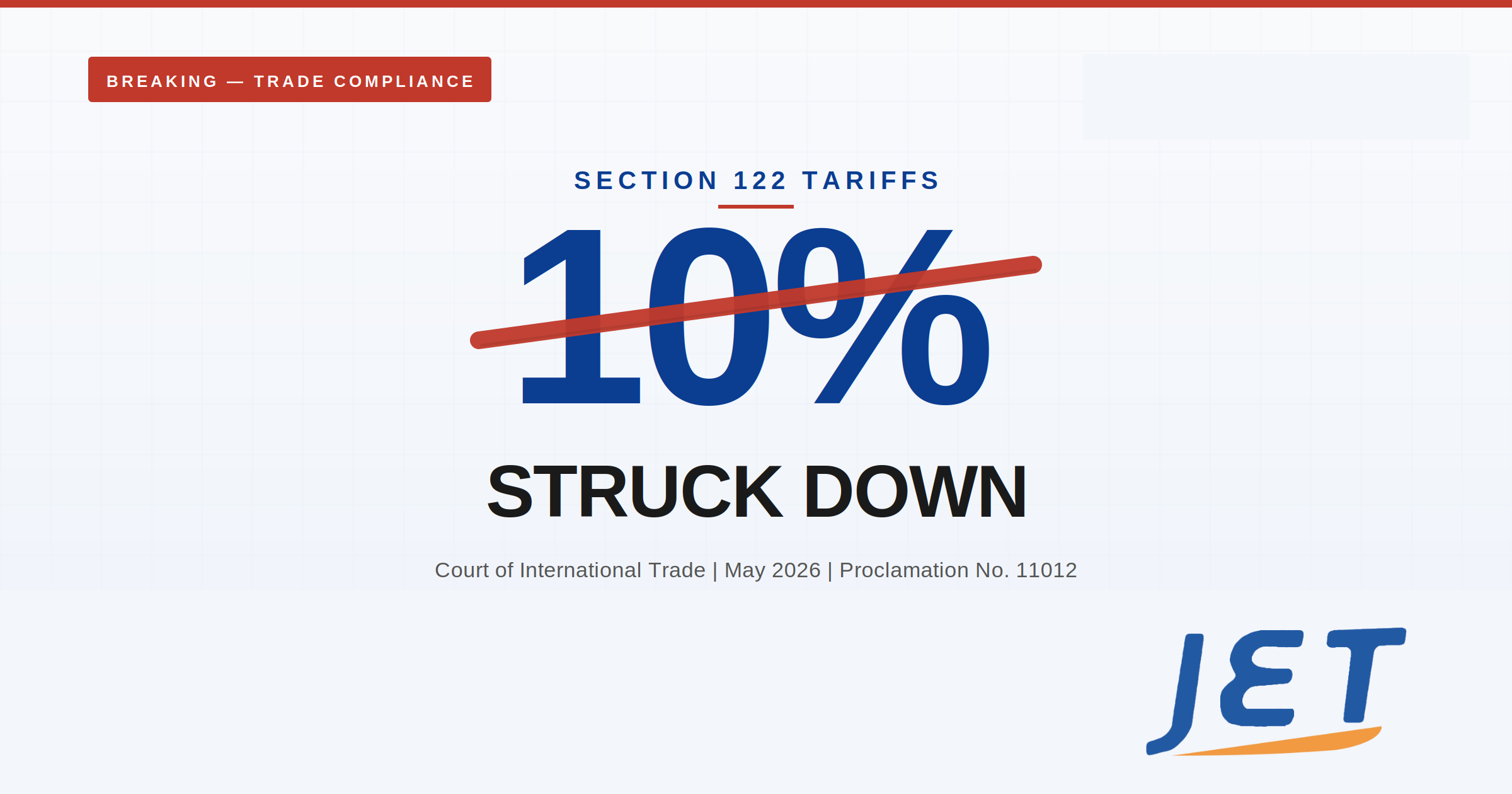
- The Court of International Trade has struck down the 10 percent Section 122 tariffs that took effect February 24, 2026.
- The court ruled that the President exceeded his authority by claiming a balance-of-payments emergency.
- Importers have paid over20 billion dollars in these tariffs so far
- An appeal to the Supreme Court is almost certain.
- The CIT did not issue an injunction. The tariffs remain in place pending appeal.
This morning the Court of International Trade handed down a ruling that, if it survives appeal, will terminate the 10 percent Section 122 tariffs, which took effect February 24, 2026.
Did the President exceeded his authority when he claimed that a balance-of-payments emergency warranted invoking Section 122. On that question, the judges were direct.
"Nowhere does Proclamation No. 11012 identify balance-of-payments deficits within the meaning of Section 122 as it was enacted in 1974." — Court of International Trade ruling, May 2026
Section 122 of the Trade Act is a narrow, time-limited tool. It gives the President the ability to impose a temporary surcharge of up to 15 percent for a maximum of 150 days in response to a fundamental international payments problem. The court is saying that the proclamation did not meet the balance-of-payments deficit as defined in the statutory language. Just declaring one is not enough.
July 24, 2026 update
The 10% Section 122 tariffs fall on Friday, July 24. Still uncertain whether many of these get replaced with new Section 301 tariffs (of 10 or 12.5%) or if only Section 232 tariffs apply? But the US just announced a new round of potential tariffs (50% on some goods).
IEEPA to Section 122 to Section 301?
The executive branch of the US government remains committed to the application of tariffs. They are turning now to Section 301 tariffs which are more burdensome to apply but likely more durable to judicial review.
The likely (some say dubious)rational for implementing Section 301 tariffs are “unreasonable or discriminatory" practices of a country. The application can include a country having excess capacity beyond their domestic market.
How we got here — the timeline
- February 24, 2026 The 10 percent baseline tariffs take effect under Proclamation No. 11012, with the administration citing Section 122 authority. This was done following the Supreme Court determining IEEPA tariffs to be invalid.
- February to May 2026 Importers across thousands of HTS codes have paid billion dollars in Section 122 duties.
- Spring 2026 Multiple lawsuits work through the Court of International Trade challenging the legal basis of the tariffs.
- May 2026 The Court of International Trade strikes down the tariffs, ruling that Proclamation 11012 failed to identify a balance-of-payments deficit as Section 122 actually defines one.
- Next 1 to 3 days An appeal to the Supreme Court is almost certain. The administration will likely seek a stay of the ruling pending that appeal, which would keep collections in place in the meantime.
Why this ruling matters
Two reasons, and they are unrelated to each other but equally important.
1. The precedent
This adds to a growing body of case law that the President's tariff-imposing power is narrow. The decision pushes future tariff action back toward the more traditional and durable mechanisms — Section 301 investigations, anti-dumping and countervailing duty proceedings, or actual congressional tax legislation. Each of those carries procedural rigour that broad presidential proclamations do not.
2. The refunds question
If the ruling holds on appeal, we are likely heading into another major refunds process for the +20 billion dollars already collected. Importers and their brokers have been able to secure refunds via CAPE for the IEEPA duties.

What importers should do now
Keep accurate records and await for a decision from the final appeal.
Start preparing regardless
- Pull a clean report of every entry that paid Section 122 duty between February 24, 2026 and the date of the ruling. By tracking number, by HTS, by liquidation status.
- Verify EIN and importer-of-record alignment in ACE for each. A mismatch will kill a refund claim faster than anything else.
- Confirm none of the entries are tied to drawback claims, reconciliation flags, or active protest or litigation. Those are the categories CAPE rejects outright, and the Section 122 process will likely follow the same pattern.
The bigger picture
The IEEPA tariff cycle taught us how the refund process can work. CAPE works great but is unforgiving. Compliant entries have never mattered more than ever as the refund process is essentially another audit.
Frequently asked questions
What did the Court of International Trade actually rule?
The court ruled that the President exceeded his statutory authority when he invoked Section 122 of the Trade Act of 1974 to impose a 10 percent baseline tariff under Proclamation 11012. The judges held that the proclamation did not identify a balance-of-payments deficit as Section 122 actually defines one, so the legal basis for the tariffs failed.
What is Section 122 of the Trade Act?
Section 122 of the Trade Act of 1974 gives the President authority to impose temporary import surcharges of up to 15 percent for a maximum of 150 days to address a fundamental international payments problem. The authority is narrow, time-limited, and tied specifically to balance-of-payments emergencies as defined in the 1974 statute.
How much have importers paid in Section 122 tariffs?
Estimates suggest importers have paid over 20 billion dollars in Section 122 tariffs since the tariffs took effect on February 24, 2026. The tariffs were in place for 72 days before the Court of International Trade struck them down.
Will the tariffs continue during the appeal?
Likely yes, at least in the short term. The administration is expected to seek a stay of the ruling pending appeal, which would keep collection in place. Importers should not assume duty stops accruing on goods entering the United States until clearer guidance from CBP is issued.
Why might the administration pivot to Section 301 next?
Section 301 is a more administrative-law-driven tariff framework. It requires formal investigations, findings, and procedural steps that emergency-authority claims under Section 122 or IEEPA do not. But it still gives the Executive Branch substantial flexibility to adjust tariff rates up or down as a negotiating tool — without requiring the emergency-authority arguments that just failed at the Court of International Trade. Expect more reliance on Section 301 investigations to support tariff actions going forward.
How do importers claim refunds if the ruling stands?
Refunds would most likely flow through the CAPE submission process, which is the same system used for IEEPA tariff refunds. Protests are filed under 19 CFR 174 within the protest window. Accurate entry data, attestation by the importer of record, and clean documentation is necessary to secure a refund.
Should I file protests now or wait for the appeal?
Protest windows run on calendar deadlines from the date of liquidation, not from the date of any court ruling. Entries that liquidated early in the Section 122 period will hit their 180-day protest deadlines regardless of whether the appeal is decided. Coordinate with your customs broker and file protests as necessary.
What is CAPE?
CAPE is the refund process for processing IEEPA tariff refunds. It is the most likely vehicle if Section 122 refunds become a reality.