International Shipping Intelligence
- €3 New per item/per line item duty on every non-EU e-commerce parcel
- 20 Postal operators warning they are not ready
- Jul 1 EU implementation deadline — no delay confirmed
- €150 Previous duty-free threshold — now eliminated
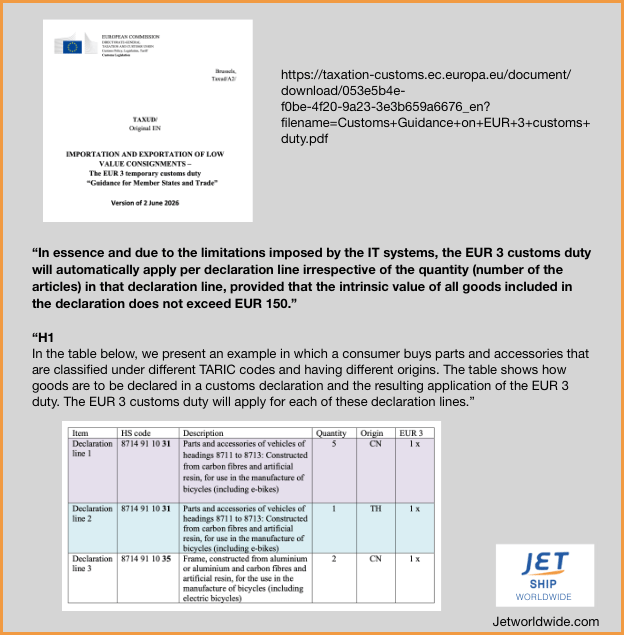
Note that the 3 EUR fee applies to each unique HS code, per declaration line:
-
"the 3EUR customs duty will automatically apply per declaration line irrespective of the quantity (number of the articles) in that declaration line, provided that the intrinsic value of all goods included in the declaration does not exceed EUR 150."
- Group multiple items of the same tariff classification per line on the invoice to avoid the 3 Euro duty being applied unnecessarily.
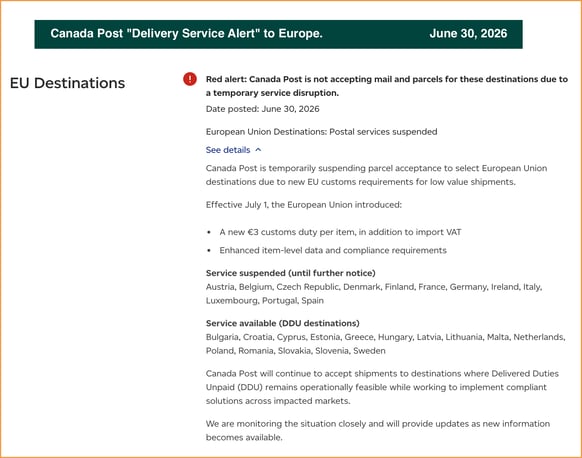
Service Alert:Canada Post has suspended parcel service to most of Europe
Effective June 30th, Canada Post has suspended service to major European Countries.
The trigger is the EU's new customs regime, effective July 1: a EUR 3 per-item duty on top of import VAT, plus item-level data and compliance requirements that postal DDU service simply cannot meet at scale.For small, occasional sellers, this is a hard stop.
For serious Canadian merchants, it is an opening. The exporters who win Europe from here will be the ones who stop relying on "easier postal clearance " and build a dedicated B2C lane: consolidation out of Canada, air freight into Europe, IOSS registration for compliant VAT collection, and reliable final-mile delivery across the EU.
Yes, there is an upfront cost to standing that up. But it turns a per-parcel gamble into a scalable system, and your unit costs fall as volume rebounds and grows.The border did not close but requires dedicated advanced logistics options. Contact our team.
How long will the Postal Suspension of Service to Europe Last?
To support the July 1st transition, postal operators continue to build new operational processes. We expect the suspension may not last longer than a week or so. However, the actual timeline remains unclear.
The several challenges that remain include:
- Incomplete or incorrect customs data may lead to customs rejection, double handling or incorrect taxation
- Finding ways to reduce recipients refuse to pay import fees by building delivery duty paid options and ways to alert consignees of pending charges prior to clearance.
- Differences in national implementation, regarding DAP acceptance, transition periods, POA requirements, or customs processes
Canadian Registered Customs Representatives (RDE)
Unlike IOSS-collected VAT, the €3 duty is charged on businesses — the seller or representative at import. That has direct operational consequences for customs brokers. In practice, this means Registered Customs Representatives (RDE) now need to cover a materially larger guarantee amount to clear parcels.
For high-volume operators, that guarantee ceiling becomes a hard operational constraint: it directly limits how many parcels a broker can clear at any given time, unless the comprehensive guarantee is renegotiated and increased upstream with customs authorities.
Locally pre-cleared, EU-held inventory avoids the pinch entirely — stock already released for free circulation and stored in the EU sidesteps this per-parcel duty and guarantee pressure on every last-mile delivery
Where this Jet Worldwide creates opportunity.

FedEx, UPS and DHL Shipments to Europe and 3 euro minimum charge
The concern is not limited to postal operators. In a separate letter to EU finance ministers, the presidents of DHL Express Europe, FedEx Europe, and UPS EMEA — writing on behalf of the European Express Association — warned that without "a stable and workable legal framework," there is a "real risk" of shipments being held at EU borders, with disruption potentially affecting medical supply availability, industrial production, and broader European supply chains.
The real-world evidence is when France brought in its own €2 parcel tax before anyone else in Europe, the volume via the Paris CDG gateway fell over 920% within a week. But, in this case, the volumes simply transferred to other European gateways. The July 1st EU-wide rollout carries similar risks that are a magnitude larger. But, perhaps, this is the policy goal all along?
What the EU Is Changing — and Why It Matters Now
For years, packages valued at €150 or less entered the EU duty-free. That exemption disappears on July 1, 2026. Under the new rules, every item in a parcel shipped from outside the EU — including from Canada — is subject to a flat €3 customs duty per item, regardless of value. VAT obligations remain in addition to this charge.
The math shifts fast. A parcel with five different items now carries €15 in duty at the EU border before a single VAT calculation. For Canadian sellers shipping apparel, supplements, accessories, home goods, or any category with modest per-unit margins, this is not an abstraction. It is a direct hit to landed cost — and if your shipping program is not set up to handle it cleanly, your customer feels it at the door.
Direct-to-consumer flows into the EU and Tariff Classification:
The EUR 3 fee - administratively - is the easy part. The real work is tariff classifications at the SKU level that will be necessary effective July 2028. At this point, actual duty rates will apply. Still time to prepare but something to keep in mind when building and updating your inventory listing.
Why Postal Operators Themselves Are Raising the Alarm
This is not speculation from logistics consultants. On May 29, 2026, the chief executives of 20 postal operators — including An Post, DHL Group, and the national postal services of France, Germany, Italy, Spain, the Netherlands, and 14 other EU member states — sent an urgent letter to European Commissioner Maros Sefcovic requesting a minimum six-month delay.
Their stated concerns reveal exactly why postal channels are the wrong infrastructure for this moment:
-
- Compliance is structurally impossible on this timeline. The final legal text arrives just four weeks before the deadline. Postal operators cannot retool systems, train staff, or update processes in that window, Non-EU operators like Canada Post face the same constraint from the other side of the Atlantic.
- Postal networks serve fragmented, low-value traffic with no alternative infrastructure. The letter specifically notes that postal operators "predominantly serve fragmented, low-value and socially inclusive traffic — SME exports and consumer-to-consumer exchanges."
- Millions of parcels face return to sender. Without proper duty documentation, the postal operators warned that "millions of parcels would have to be returned." (If your shipments move through Canada Post or a European postal network, your parcels are in that pool.)
- Inconsistent enforcement across EU member states. The short implementation timeline risks "divergent interpretations" across different EU customs authorities — meaning the same shipment could be handled differently in Germany versus Spain versus Ireland. Jetship imports via France.
- The European Commission is not backing down. Despite the letter, the Commission confirmed its timeline remains unchanged. A guidance document was published, but the deadline stands.
The Honest Problem With Canada Post and Postal Solutions for EU Shipping
Canada Post has served Canadian e-commerce sellers well for domestic and some international volume. But the new EU customs environment exposes the fundamental limitations of postal infrastructure for cross-border B2C shipping into a regulated single market.
| Capability Required | Canada Post / Postal Networks | Jetship Dedicated Program |
|---|---|---|
| Prepaid duty collection at checkout (DDP) | Not supported | Supported |
| Per-item €3 duty declaration and remittance | Not ready — operators' own admission | Built into program design |
| Consolidated customs documentation | Individual parcel level only | Consolidated manifest with full compliance data |
| VAT Payment | Being established | Can be arranged |
| Consistent customs treatment across EU member states | Varies — divergent enforcement risk flagged | Routed through one consistent clearance point. |
| End-to-end tracking visibility for EU delivery | Limited after handoff to EU | Full visibility through final delivery |
| Scalable for B2C e-commerce volume | of course.. but eventually | Designed to help you scale |
This is not a criticism of Canada Post as a carrier as we still recommend Canada Post for personal shipments to Europe. And we support their universal coverage mandate and support of small businesses. But the "easier postal clearance advantage" is no longer a thing.
The EU's new customs framework demands conformity regardless of carrier, postal or commerical clearance. A purpose-built program has its own limitations but - at the same time - give a real opportunity to scale your sales to Europe. Including taking advantage of duty free import via CETA.

How Jet Worldwide Builds a Better European Shipping Program
Jet Worldwide helps Canadian ecommerce sellers replace postal-channel EU shipping with structured, scalable programs built specifically for the post-exemption customs environment. Here is what that looks like in practice:
Parcel Consolidation into Europe
Jet aggregates yourCanadian B2C shipments and moves airfreight into European markets.
Prepaid Duty and VAT — Delivered Duty Paid
Under a DDP program, duty and VAT are collected before the parcel reaches EU customs — meaning your customer pays a known all-in price at checkout with no surprise charges on delivery. Under the new €3-per-item regime, this is actually easier to calculate and administer.
Proprietary Import Process — Your Program, Not a Shared Network
The biggest risk of relying on postal channels is delays in an overwhelmed system. Jet builds you a proprietary import lane: a dedicated customs broker, consistent clearance routing, and a documented processes.
Direct Shipping to Europe — No Postal Handoff
Jet routes shipments directly into European distribution without handing off to the postal networks that are publicly warning they cannot handle the new duty requirements. Direct routing provides full tracking visibility, eliminates the postal last-mile uncertainty that accounts for most EU delivery failures, and keeps your shipments out of the fragmented postal backlog the new customs rules are about to create.
If You Are Still Shipping to Europe Through Canada Post, It Is Time to Change That
The postal operators signing letters to the European Commission are not warning about a minor administrative adjustment. They are describing a system that is not ready for the new rules — and asking for more time because the consequences of proceeding unprepared are serious: returned parcels, customer complaints, compliance exposure, and lost sales.
Canadian sellers do not need to accept that risk. Jet Worldwide exists precisely to build the kind of structured, documented, duty-paid European shipping program that postal channels cannot provide. Whether you are shipping 50 parcels a week to the UK and Germany, or building out a serious European market strategy across multiple countries, we can build you a program that works under the new rules — and keeps working as those rules evolve.
Source: An Post CEO David McRedmond and 19 European postal operators, open letter to Commissioner Maros Sefcovic, May 29, 2026. Reported by The Irish Times. European Commission response, June 2026.
Frequently Asked Questions
Common questions from Canadian ecommerce sellers about the EU's new customs rules and alternatives to postal shipping.
What exactly is the EU's new €3 parcel duty and when does it start?
Starting July 1, 2026, the European Union will apply a flat customs duty of €3 per item on all goods purchased online from non-EU countries. This applies to every item inside a parcel — not per parcel, per item. A parcel containing three products carries €9 in duty. A parcel containing six products carries €18 in duty. This replaces the previous rule that allowed packages valued at €150 or less to enter the EU duty-free. That exemption no longer exists.
Does this new EU duty apply to Canadian sellers?
Yes. The new €3-per-item duty applies to all online purchases shipped from any non-EU country to an EU consumer. Canada is included, along with the United Kingdom, the United States, Switzerland, Norway, and all other non-EU origin countries. There is no exemption for small sellers or low-volume shippers.
If you are selling to customers in Germany, France, the Netherlands, Ireland, or any other EU member state, this duty applies to your shipments.
Why are so many postal operators saying they are not ready for the July 1st deadline?
On May 29, 2026, twenty postal operators — including An Post (Ireland), DHL Group (Germany), and the national postal services of France, Italy, Spain, Belgium, the Netherlands, and 13 other EU member states — signed an open letter to the European Commission requesting a six-month delay.
Their core reasons were as follows. The final legal text of the new rules will not be available until just four weeks before the July 1st deadline, making technical compliance impossible. The duty collection system depends on non-EU operators like Canada Post being ready to capture and transmit the correct data — and those systems are not built for per-item duty declaration at scale.
Without proper documentation, millions of parcels will be returned to senders rather than delivered. Despite this letter, the European Commission has confirmed its deadline remains unchanged.
Why is Canada Post not a good solution for shipping to the EU under the new rules?
Canada Post and other postal networks were designed to move individual parcels between senders and recipients with simpler "postal clearance" processes. Most often, these did not include having to manage duty charges.
The new €3-per-item duty requires that duty be declared, collected, and remitted correctly before or at EU customs clearance.
Canada Post - and postal resellers in Canada -do not offer a Delivered Duty Paid (DDP). Furthermore, they do not provide a dedicated importer of record in EU markets. The hand off from Canada post to EU postal networks that have publicly stated they are not ready for the new regime.
What is Delivered Duty Paid (DDP) shipping and does my business need it for the EU?
Delivered Duty Paid (DDP) means that the seller — not the buyer — is responsible for paying all customs duties and taxes before the parcel reaches the customer. Under a DDP program, the duty and VAT are calculated at checkout and remitted to the relevant customs authority before or at the point of clearance.
Using a dedicated clearance process, this can be achieved.
What does Jet Worldwide offer as an alternative to Canada Post for shipping to Europe?
Jet Worldwide builds purpose-built European shipping programs for Canadian companies. This includes parcel consolidation from Canada into Europe to reduce per-unit costs, Delivered Duty Paid programs that collect and remit €3-per-item duty and VAT before customs clearance. A Jet program is built specifically for your business — with consistent documentation, predictable transit, and compliance.
Talk to a Jet specialist about your EU shipping program →
How do I know if my current EU shipping setup is ready for the July 1st changes?
Ask your current carrier or shipping provider three questions. First: do you offer Delivered Duty Paid (DDP) service into the EU. member states?
Second: do you have an established importer of record in the EU markets I ship to manage IOSS/ VAT?
Third: can you guarantee my parcels will clear EU customs without being held or returned due to incomplete duty documentation after July 1st?
Request a free EU shipping assessment from Jet →